

Writing original content does not mean discovering every fact independently. Authors can research books, academic studies, official documentation, interviews and other publications. The essential requirement is to avoid presenting other people’s ideas as entirely your own. Understanding how to avoid plagiarism is therefore an important part of responsible content production.
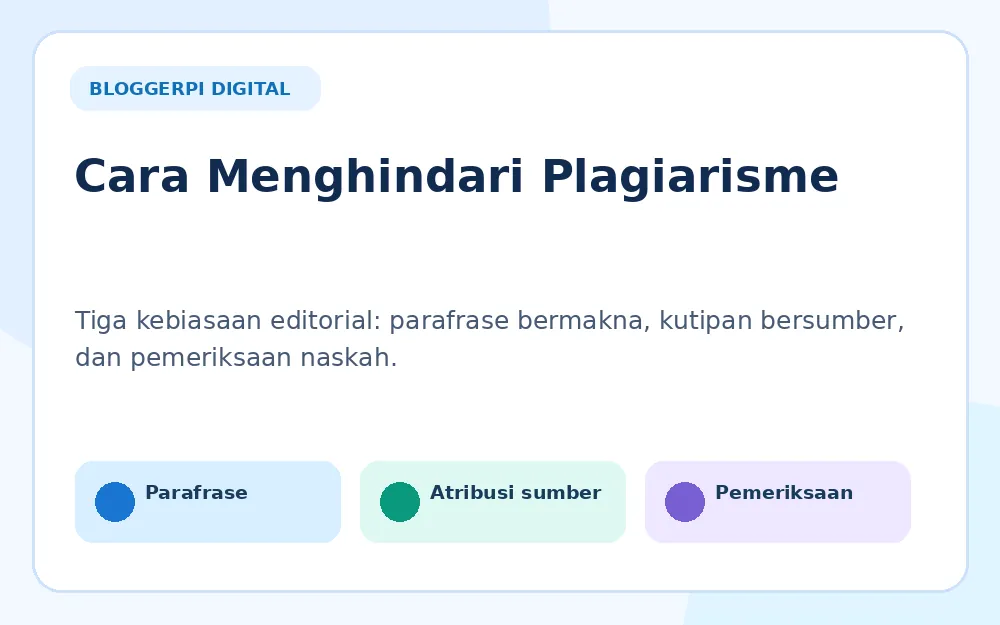
For content writers, bloggers and digital marketing teams, plagiarism affects both writing ethics and editorial credibility. This guide presents three practical safeguards: accurate paraphrasing, quotations with proper attribution, and checks using appropriate tools, with examples of how to apply each in an editorial workflow.
What Is Plagiarism in Content Writing?
Plagiarism is the use of another person’s words, ideas, argumentative structure, or work without proper acknowledgement of the source. This can take the form of copying a paragraph, substituting synonyms and then claiming it as one’s own, or using specific ideas without citing the source.
Plagiarism needs to be distinguished from copyright infringement. The two may be related, but not identical. Plagiarism concerns honest attribution, while copyright infringement concerns the use of protected work without proper permission or exceptions. A work may have attribution issues even if copyright infringement does not necessarily occur, and vice versa.
In editorial practice, the primary goal is to produce work with original explanation, sound argumentation, relevant examples, and transparency of sources. Guidelines steps to create articles for beginners can be the basis for compiling a writing framework before starting research.
Why Should Plagiarism Be Avoided?
Maintaining Reader Trust
Readers rely on articles for verifiable information. Cite sources when using someone else’s ideas helps them assess the context and credibility of the information. When a site simply repackages someone else’s material without contributing, trust in its editorial quality is undermined.
Respecting the Creator and Source
Researchers, journalists, writers, photographers, and authors of works deserve proper recognition for their contributions. Including references doesn’t diminish the quality of the writing; it actually makes the argument clearer.
Producing Useful Content for SEO
Google has a policy against large-scale copying or content creation practices aimed at manipulating search results without providing value to users. However, it’s important not to equate every similarity in text with an automatic penalty. The key issues are quality, purpose, and added value for readers.
When writing for a business website, article quality is best built through research, real-world examples, a clear structure, and up-to-date information. See also the guidelines how to create SEO-friendly articles to align reader needs with search optimization.
3 Ways to Avoid Plagiarism in Writing Content
1. Understand the Source, Then Paraphrase Correctly
Paraphrasing is a restatement of ideas from a source using your own language and structure. This process differs from simply replacing a few words with synonyms. A good paraphrase demonstrates that the writer understands the material, selects relevant information, and is able to explain it in the context of the intended audience.
Even though the sentence has been rewritten, ideas that come from other people still need to be attributed if not common knowledge. The Purdue Online Writing Lab emphasizes the importance of citing sources when paraphrasing.
Steps to Paraphrase Without Copying the Original Pattern
First step: Read the source until you understand its main point. Identify conclusions, evidence, limitations, and terms that should not be misinterpreted.
Second step: Close or set aside the original text for a moment. Write down the main ideas in concise bullet points, then structure the explanation using a structure appropriate to the needs of the new article.
Step three: Write in your own words and include additional context that’s genuinely useful. For example, explain how a practice applies to a small website, rather than simply repeating the definition.
Fourth step: Compare the results with the source to ensure the meaning remains accurate, no sentences are too similar, and all important claims are properly attributable.
Examples of Inaccurate and Better Paraphrases
For example, a source explains that hosting stores website files on a server so they can be accessed over the internet. Rewriting it as ‘hosting is where website files are stored on a server computer so they can be accessed online’ simply changes a few words without providing any new explanation.
A more useful version might read: ‘When a visitor types in a domain address, the hosting server provides the files and data necessary for the browser to display the page. Therefore, the quality of the connection and the server’s capacity also affect the visitor’s experience.’ If the explanation is developed from a specific source’s ideas, cite the source.
2. Use Direct Quotes and Source Attribution Appropriately
Direct quotations are used when the original sentence structure needs to be preserved, such as an official definition, a source’s statement, or relevant interview results. Place the quoted material within quotation marks or block quotation marks in accordance with editorial style, then provide adequate source information.
When is a Direct Quote Required?
Use direct quotations when the original words are essential and cannot be restated without losing nuance. Avoid cluttering the article with lengthy quotations that diminish personal analysis. Quotations should be concise, proportionate, and do not exceed applicable usage rights.
What Information Should Be Included?
For web articles, attribution typically includes the name of the author or organization, the title of the publication, a link to the source, and the date, if relevant. If using research, cite the methodology and its limitations if they affect the interpretation of the data.
A statement such as “based on Google Search Central documentation” is stronger if followed by a link to an authoritative page that specifically addresses the claim. Avoid using generic references that do not support the paragraph’s content.
3. Use Similarity, Spelling, and Source Checking Tools
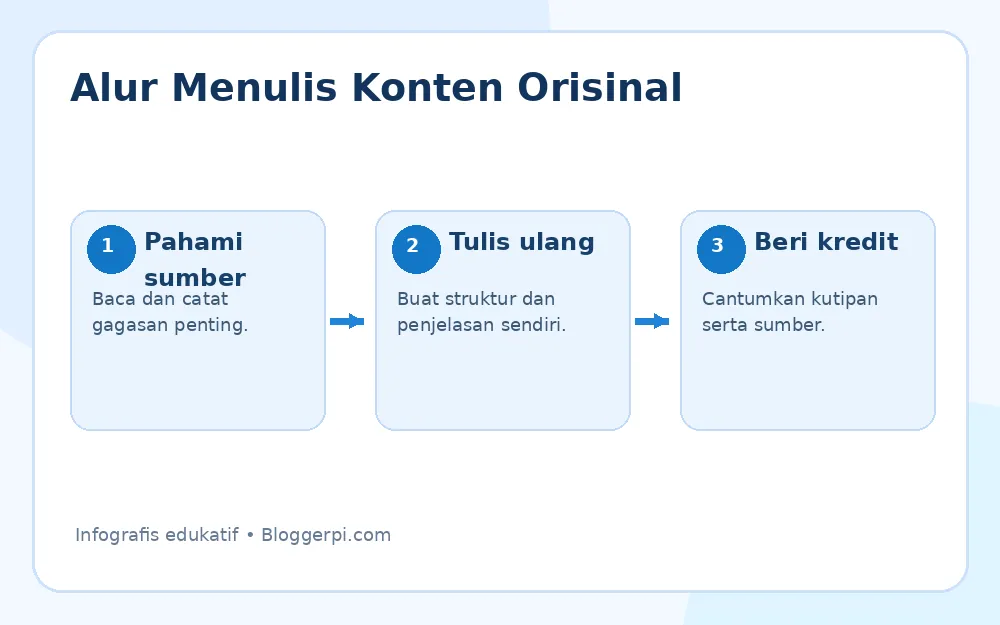
Digital tools are useful for finding problems before an article is published. However, each type of tool has a different function. Spell checkers help correct typos or grammar, while similarity checker It compares the similarity of text to a collection of documents it has access to. It’s incorrect to call an automatic spell checker a plagiarism detector.
Similarity Checker: Understanding Its Strengths and Limitations
Similarity checking services can identify identical or similar sections of text. The results should be read manually, as proper citations, technical terms, bibliographies, and common phrases can also reveal similarities. Conversely, a low similarity score does not guarantee that an idea has been correctly attributed.
Because each service’s database coverage varies, no single percentage score can be definitive proof that a piece of writing is plagiarism-free. Do not send confidential documents to third-party tools without reviewing their privacy policies and data processing rights.
Spelling and Grammar Checker
Use a spell checker to improve readability, but don’t assume it can verify the originality of ideas. For Indonesian, pay attention to consistency of terminology, punctuation, and appropriate vocabulary references. Autocorrect results should still be reviewed because the context of the sentence can vary.
Reference Notes and Editorial Workflow
A reference tracking tool, source spreadsheet, or citation manager helps record URLs, authors, publication dates, and claims used. In content marketing teams, this practice makes it easier for editors to verify and update articles when information changes.
Also learn skills needed by SEO content writers, including research, information organization, and the ability to convey content clearly.
Anti-Plagiarism Checklist Before Article Publication
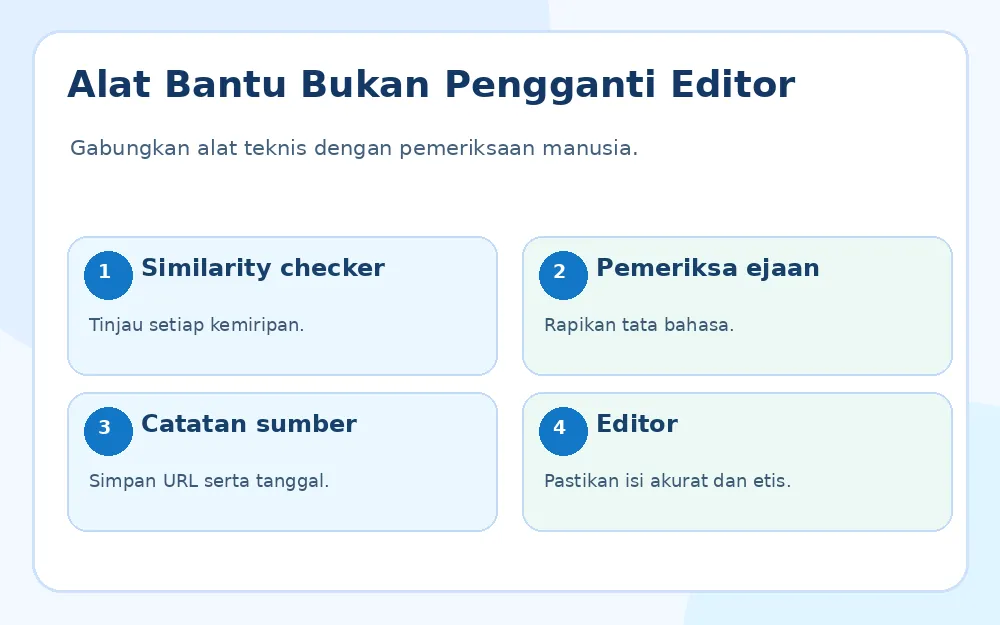
Check the Origin of Each Specific Claim
Match figures, dates, research results, and technical statements with the source documents. If you cannot trace the origin of a claim, it’s best to delete it, soften it, or find a stronger basis before publishing it.
Check All Paraphrases and Quotes
Make sure the paraphrased section maintains the original structure and properly cites the source. Direct quotations should be faithful to the original text, use quotation marks, and include attribution.
Check Illustration Authenticity and Usage Rights
Images from the internet are not automatically free to use just because they can be downloaded. Review the license, commercial use permissions, attribution requirements, and platform terms. Keep a license file or proof of permission if necessary.
Add Your Own Knowledge and Perspective
Articles will be more useful if the author includes experiences, explanatory test results, case studies, or a decision-making framework. Avoid simply copying paragraphs from various websites and then substituting synonyms for them.
Perform Final Technical Inspection
Check source links, internal links, spelling, H2/H3/H4 heading structure, image alt text, and terminology consistency. Note the date of the check for articles that require frequent updates.
Mistakes Content Writers Often Make
Relying on Article Spinner
Automatic word replacement often preserves the structure or ideas of the source without contributing anything new. This can also reduce readability and accuracy of terms. See the explanation below. what is an article spinner to understand the limits and risks.
Citing Secondary Sources Without Checking Primary Sources
A blog might cite research data but add a misinterpretation. If possible, consult the original report or documentation to verify the figures, context, and year of publication. Link to primary sources within the article when they are most relevant.
Assuming AI Content is Original
AI can help generate ideas, but its output isn’t necessarily correct, substantially different, or free from similarities that need to be checked. Continue fact-checking and insight-based rewriting. Google’s policies highlight large-scale misuse of content that doesn’t add value to readers, regardless of the authoring tool.
Assuming that citing the source allows full copying
Attribution and usage rights are two different issues. Adding a link to a source does not automatically grant permission to copy the entire article, photo, or copyrighted material. If you encounter content theft, understand the steps. reporting content through DMCA procedures, in accordance with relevant conditions and laws.
Frequently Asked Questions
Is paraphrasing without sources considered plagiarism?
Yes, especially when someone else’s specific ideas are presented without attribution. Changing the sentence doesn’t necessarily eliminate the need to cite the source.
What percentage of similarity is considered safe?
There is no universal number that guarantees safety. Percentages should be interpreted based on the source of similarity, institutional regulations, and the context of the article. Manual review is far more important than relying on a single number.
Can spell checker detect plagiarism?
Not automatic. Spelling tools focus on language and writing; text similarity tools have a different function. Neither can replace editorial judgment.
Does all information in an article have to be cited?
Facts that are common knowledge usually don’t require citation, but specific claims, research results, quotes, statistics, and ideas derived from the work of others need to be properly attributed.
Conclusion
The three most effective habits for avoiding plagiarism are understand the source before paraphrasing, quote with clear attribution, and use aids critically. Complement this process with your own fact-checking and editorial contributions. The result is not only more original articles, but also content that is useful, trustworthy, and easily accountable to readers.
Reference
- Purdue OWL — Paraphrasing: Write It in Your Own Words.
- Purdue OWL — Quoting, Paraphrasing, and Summarizing.
- Google Search Central — Spam Policies.
