

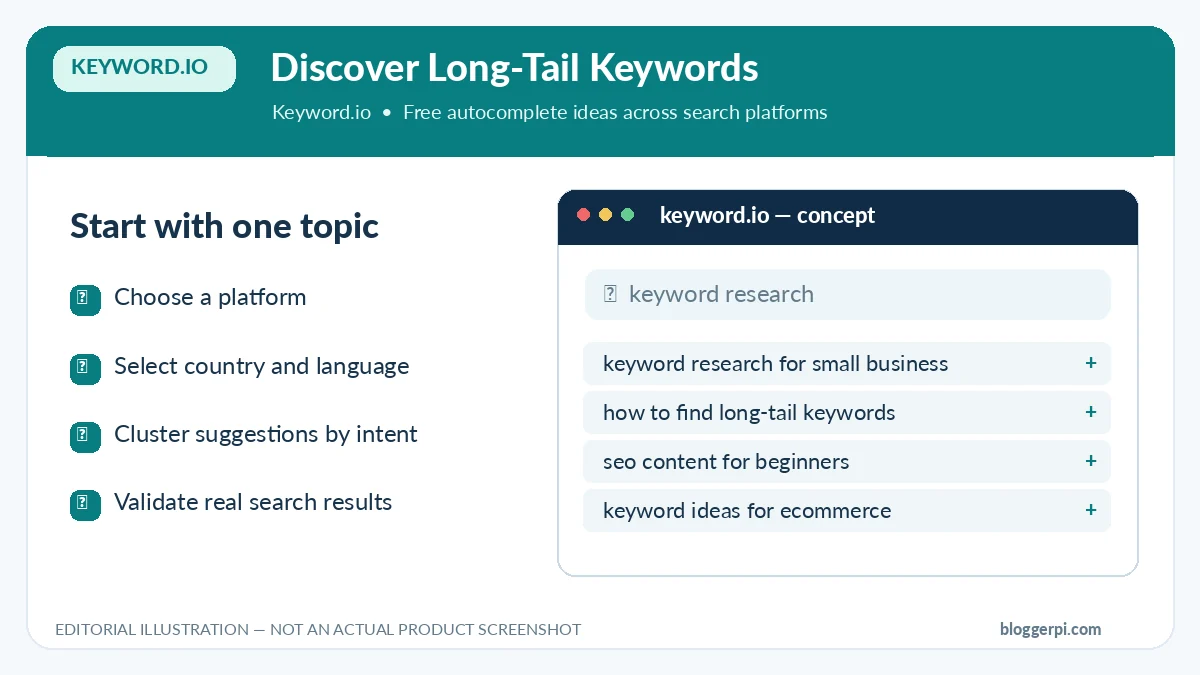
Long-tail keyword research with Keyword.io can help publishers, small businesses, agencies, and ecommerce teams uncover specific questions that broad topics hide. The tool gathers autocomplete suggestions from platforms including Google, YouTube, and Amazon. A practical process involves choosing a platform, selecting relevant geography, collecting phrases, grouping by search intent, and inspecting real search results before planning pages. Autocomplete is not a verified monthly search-volume report or evidence that a keyword will be easy to rank for. This 2026 guide explains the free discovery workflow, the limitations of its data, and how to connect research to useful content.
Understand what long-tail keywords represent
Long-tail keywords reflect the more specific side of search demand. A broad phrase such as “running shoes” leaves the user’s goal uncertain; “how to choose running shoes for beginners” conveys a more identifiable question. Such queries often mention a task, budget, location, or audience. Long-tail does not depend on a rigid minimum number of words: the idea involves specificity and the overall distribution of search phrases.
For a small business, researching these questions can reveal where tutorials and commercial pages should fit into the customer journey. It does not mean every long phrase has low competition or automatically produces sales. Determine what a useful answer would look like and connect your research to measurable SEO objectives rather than simply counting ideas.

Distinguish Keyword.io from similarly named products
Keyword.io operates at keyword.io, while KeywordTool.io at a different domain is a separate product with different features. Google Keyword Planner is likewise a different tool connected to Google Ads and advertising research. Verify the actual address before copying an old tutorial, signing in, or purchasing an upgrade. A common SEO mistake is to quote prices or features from the wrong service because the brand names look similar.
The official Keyword.io Google tool explains that free autocomplete suggestions can be searched and exported, although interactive tools require JavaScript and saving managed lists can involve account registration. An autocomplete list is not a verified search-volume report. See our comparison of SEO research tools for a broader view of tool categories, limitations, and use cases.
Step 1: choose a platform and geography
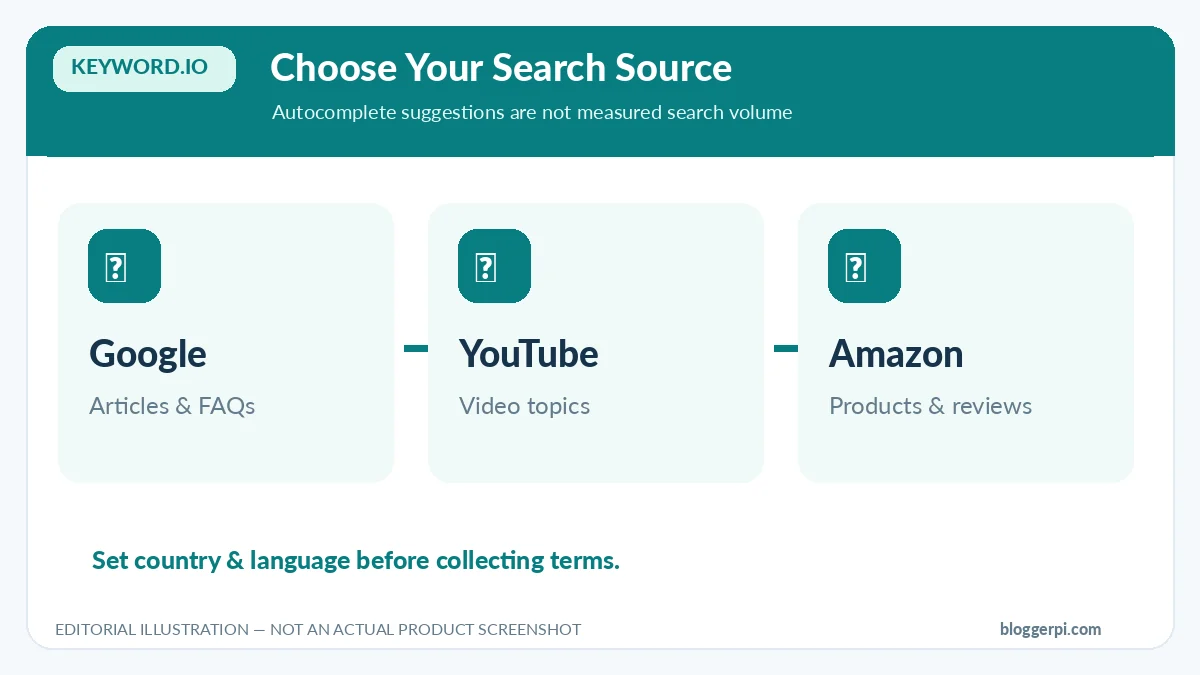
Open Keyword.io’s Google Longtail Keyword Tool and select the source that matches the research task. Google is useful for web content questions, YouTube for video topics, and Amazon for product-related queries. The official interface also lists other sources including Bing, TikTok, and ecommerce platforms. The behavior of a person browsing a marketplace can differ materially from a person using Google for advice.
Select the country and language relevant to your audience. A local retailer in Yogyakarta should not automatically use the same suggestions as a global English ecommerce company. Results can vary by geography, language, time, and source. Note these settings in your research sheet so another editor can repeat the exercise. Connect this decision to market segmentation rather than treating all language markets as interchangeable.
Step 2: define a useful seed keyword
A seed keyword is the starting subject from which the tool produces more specific variations. Consider a store selling educational printables: it might start with “preschool worksheets” and then investigate possible interests related to emotions, age groups, letter tracing, or home-learning activities. These are hypothetical editorial examples, not measured Keyword.io outputs or claims of current search demand.
Build seeds from customer questions, contact-form messages, user interviews, comments, and topics already attracting organic visitors. Someone responsible for content planning can balance the audience’s interests with production capability. Avoid vague seeds disconnected from a real reader problem, since a large list of irrelevant suggestions only increases filtering work.
Step 3: gather autocomplete phrases without inventing volumes
Run a search using your seed and review the phrases that the tool returns. Repeating the search with closely related seeds can broaden the possible questions, but autocomplete is not a database of exactly how often each phrase is searched. A suggestion’s order should not be treated as a ranking-difficulty score or a forecast of potential revenue. Do not assign fabricated monthly numbers to terms simply because they appear on the screen.
Remove duplicates and phrases that express the same need using slightly different words. Keep candidates that align with an identifiable task. For example, a buying guide and a product page might legitimately have different intentions, but several variations of one beginner question may belong in a single comprehensive guide. Inspect competing search results to understand what useful material already exists.
Step 4: classify search intent
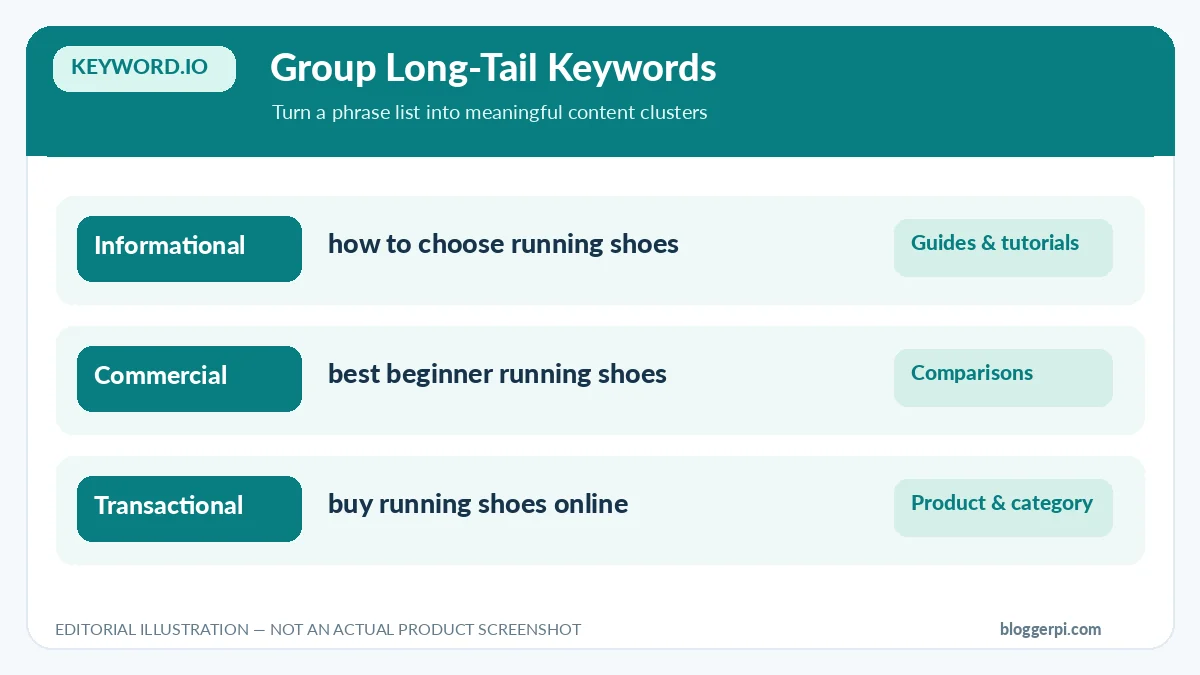
Search intent is the underlying reason a person makes a query. Informational phrases ask for explanations, commercial-investigation queries compare alternatives, and transactional queries often look for a product or service page. These classifications are helpful working hypotheses rather than labels that can be determined from wording alone. Inspect the actual search results before finalizing the page type.
A good content plan does not turn every keyword into a new blog post. A detailed FAQ may be the best destination for several related questions; a store category may better serve product comparisons; a service landing page may be appropriate for an inquiry with a clear purchase intent. Mapping the purpose first reduces duplication and makes internal links more relevant.
Informational, commercial, and transactional examples
An informational phrase such as “how to choose running shoes” might require a practical checklist about fit, comfort, running surfaces, and limitations. Commercial research such as “best running shoes for beginners” may call for a comparison of selection criteria, verified product attributes, and transparent affiliate relationships. A transactional phrase such as “buy running shoes online” can be better served by a clear shopping page with inventory and return information.
The examples in this guide are illustrations of intent, not claims that Keyword.io returned measured search-volume values. Avoid pretending to have tested products or visited businesses when you have not. Content authority comes from accuracy, a helpful structure, and transparent sourcing, not from repeating the target phrase or manufacturing credentials.
Step 5: examine the real search results
Search Google or the relevant platform for a shortlisted phrase. Observe whether its results are mostly articles, videos, shopping listings, local businesses, forums, or official sources. Read representative results and identify the needs already met as well as legitimate opportunities for clearer explanations. Results can change by device, country, localization, and date, so keep notes about the context rather than making broad ranking claims from one search.
If the topic involves regulations, prices, transportation schedules, or software interfaces, verify the actual information from reliable and current sources. The goal is not to copy competitors but to make a better page for the intended reader. These habits become increasingly important as SEO and AI-assisted discovery practices evolve and low-value repeated content becomes easier to create.
Example: an educational ecommerce shop
A small seller of children’s learning materials may begin with “preschool worksheets” and discover separate questions about age groups, emotions, alphabet recognition, and printable formats. A parent-oriented guide could explain how to choose an appropriate activity, while a product page should identify the exact included files, price, and usage rights. The right content type depends on what the search results and customers reveal.
Avoid publishing a separate page for every tiny synonym if all those pages would deliver the same explanation. Group related information, add useful illustrations or activities, and make the relationship between advice and product offerings clear. These example phrases are not verified traffic statistics or a promise of conversions; they demonstrate how to plan from a broad topic.
Example: a destination publisher
A travel publisher researching “Yogyakarta itinerary” could distinguish family outings, weekend trips, public transport, and budget travel. Use the Google platform for web guides and YouTube when the planned material is a video. Travel information requires a separate verification step for attraction opening hours, ticket prices, and transport services, which cannot be safely inferred from autocomplete suggestions.
A blog post about a route may have a different structure and keyword intent from a video showing the journey. For video-specific planning, use YouTube keyword research methods and check the formats viewers expect. The right platform choice matters more than collecting the maximum number of suggestions in one session.
Example: a B2B service provider
An agency may begin with “website SEO audit” and identify potentially different needs: a do-it-yourself checklist, cost expectations, example reports, and a consultation service. An article that teaches an audit and a landing page that explains a professional service should have distinct purposes. The research should help prospects navigate between them where useful, not create competing pages that repeat the same sales pitch.
Evaluation can also draw on business SEO objectives and KPI examples. A highly relevant question that leads to a qualified inquiry may matter more than a broad phrase with impressive estimated interest. State what is measured and what is only a hypothesis when presenting your strategy.
Step 6: build keyword clusters and URL mappings
Create a worksheet containing the seed term, suggestion, platform, country, language, intended audience, search intent, page format, proposed target URL, research notes, and editorial status. Cluster phrases that share a meaningful goal. When existing content already addresses a cluster well, consider improving that resource instead of publishing another near-duplicate article.
Check that each target URL fits the navigation and XML sitemap strategy. If a large content library has overlapping topics, a cluster map can expose keyword cannibalization and opportunities for clearer linking. Simple data visualization techniques can make the planned topical structure easier for stakeholders to review.
Step 7: know when additional keyword metrics are necessary
Keyword.io’s autocomplete output is a starting point for discovery, not a complete measurement of market size. When a decision requires numeric estimates, advertising planners can review Google Keyword Planner and its methodology, access requirements, and forecast limitations. CPC and paid-search competition are different from the difficulty of achieving organic rankings, and neither should be presented as a guaranteed outcome.
Google Trends provides relative interest patterns and can help evaluate seasonality, but it is not a direct source of exact monthly search counts for every long-tail phrase. Our Google Trends guide explains how to compare topics and regions. A missing number should be marked unavailable rather than replaced with an unsupported estimate.
Step 8: create an editorial research brief
A useful brief includes the audience problem, primary question, secondary questions, evidence sources, page type, target URL, and examples the writer can verify. It should explain how the article adds value beyond existing search results and whether any claims require updated references. The brief can be short for a simple tutorial and more detailed for technical, financial, or regulated subjects.
Avoid making every H2 a mechanical variation of the focus keyword. Write headings that guide a reader through a task, such as choosing a source, evaluating intent, and organizing content. Use our meta description writing principles so the search snippet’s promise accurately reflects the material on the page.
Step 9: turn the findings into a repeatable workflow
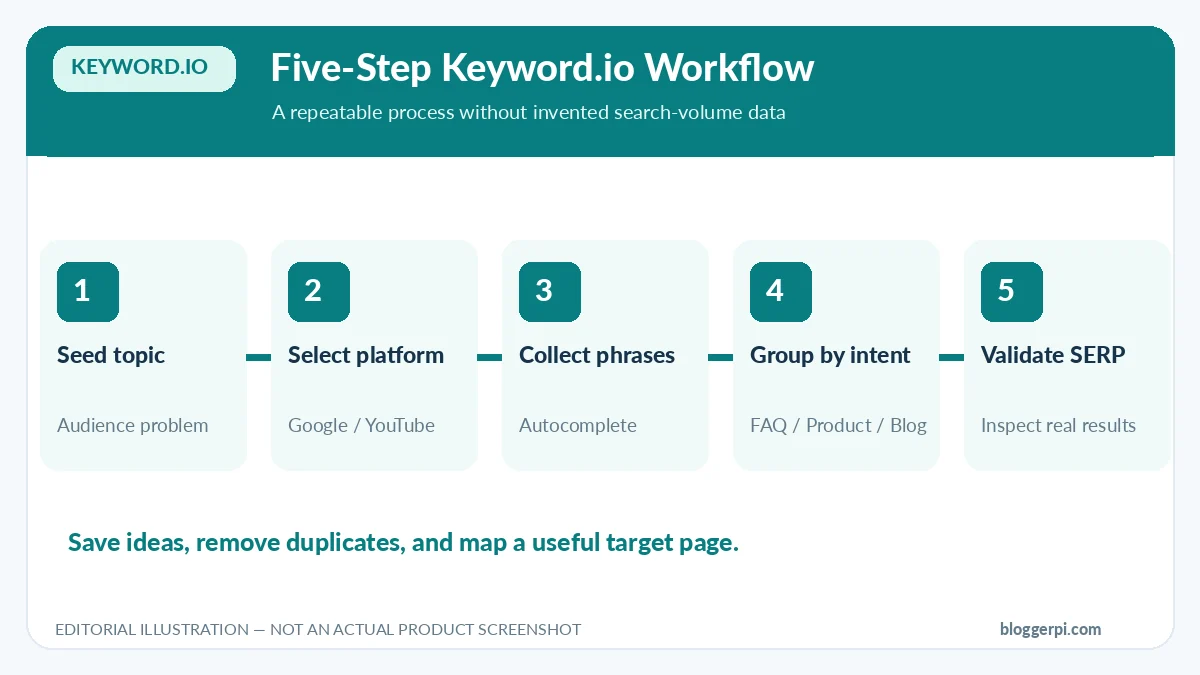
Begin with one audience problem, select the relevant Keyword.io platform, and collect suggestions using a few focused seeds. Remove duplicates and label the intent behind each phrase. Validate representative search results and choose the most helpful content format, then assign a draft to an editor with source links and a clear target page.
After publication, inspect your own performance rather than assuming keyword research guarantees growth. Connect production tasks to a content calendar so discoveries lead to maintained resources. If one article already answers a query, update it and improve internal navigation instead of increasing the number of low-value URLs.
Common mistakes to avoid
A recurring mistake is interpreting every autocomplete phrase as high-volume or low-competition. Others include mixing Google and ecommerce audience intent, ignoring country and language, publishing one page for every keyword variation, and writing titles that make promises the article cannot fulfill. These shortcuts make a site look busy while reducing the actual usefulness of its content.
Distinguish observations from tool estimates and editorial assumptions. Do not claim to have verified a live search volume that was never displayed or measured. Maintain a record of the research context and update information when customer behavior or the underlying software changes.
Frequently asked questions
Is Keyword.io free to use?
The official Google long-tail tool describes free searching and exporting of autocomplete suggestions, while certain managed-list functions can require registration.
Is Keyword.io the same as KeywordTool.io?
No. They are distinct tools and domains with different features and pricing.
Does autocomplete show monthly search volume?
No. It provides suggestions that can guide additional research but not a verified monthly count for each phrase.
How many words must a long-tail keyword have?
There is no universal minimum. Specificity and the distribution of searches matter more than an arbitrary word count.
Does each keyword need its own article?
No. Related questions with the same intent may be addressed more effectively in one comprehensive resource.
Can Keyword.io help research YouTube topics?
Yes, the YouTube source is available, but ideas should be validated against current YouTube search results and relevant audience data.
The most reliable workflow combines keyword ideas, intent verification, a coherent website structure, and performance analysis. Research is successful when it helps an editor answer real questions more accurately, not when a spreadsheet merely contains thousands of phrases.
Official sources
- Keyword.io — Google Longtail Keyword Tool
- Keyword.io — Free Keyword Research Tool
- Google Search Help — How autocomplete predictions work
- Google Search Central — Google Trends for research
- Google Ads Help — Use Keyword Planner
- Google Search Central — Helpful content guidelines
