


Bloggerpi.com — Google has confirmed the rollout of its November 2026 core update, a broad update to Google Search ranking systems. The company’s official Search Status Dashboard records the beginning of the incident on November 10, 2026, at 10:06 a.m. PST, followed by a release entry at 10:07 a.m. PST. For readers in Western Indonesia, those timestamps correspond to November 11 at 1:06 a.m. and 1:07 a.m. WIB. Google says the rollout may take up to two weeks and applies globally, across all languages.
In its brief announcement, Google Search Central described the change as a regular update intended to surface more relevant, satisfying content for searchers from all types of sites. The statement does not list particular ranking signals, industries, technologies, or page categories affected by this release. For publishers and SEO teams, this is an important distinction: the announcement confirms a broad ranking update, but does not justify claims that a specific tactic has suddenly become more or less powerful.
Ranking movement may become visible during the rollout. Yet a decline or improvement on any particular day is not, by itself, proof that the November update caused it. Technical changes, shifts in demand, seasonal patterns, and competing pages must be considered. Our overview of Google algorithm updates and the historical update timeline provides useful background for distinguishing announced updates from ordinary volatility.
November 2026 Google Core Update: Key Facts
| Item | Confirmed information |
|---|---|
| Official name | November 2026 core update |
| Category | Broad Google Search core update |
| Dashboard incident start | November 10, 2026, 10:06 PST |
| Recorded release | November 10, 2026, 10:07 PST |
| Affected service | Ranking |
| Geographic and language scope | Global; all languages |
| Expected rollout | Up to two weeks, not a guaranteed finish date |
| Stated purpose | Better surface relevant and satisfying content from all kinds of sites |
| Status in the initial November 11 report | Rolling out; completion not yet confirmed |
The one-minute difference between the incident start and the release entry is normal dashboard chronology, not evidence of two separate updates. Likewise, calculating a date approximately two weeks ahead is a planning estimate, not an official end date. Site owners should revisit the dashboard before publishing any definitive completion announcement.

What Google Search Central Actually Said
Google’s announcement reads: “Today we released the November 2026 core update to Google Search. This is a regular update designed to better surface relevant, satisfying content for searchers from all types of sites. The rollout may take up to 2 weeks to complete.” The concise wording emphasizes relevance and user satisfaction, two longstanding objectives of Google Search, without providing technical details about the underlying adjustments.
The phrase “from all types of sites” warrants attention. Google’s statement is inclusive rather than limited to major publishers, small blogs, ecommerce stores, or corporate websites. That does not mean every site receives equal exposure or every search query will change. The results vary with user intent, language, location, and competing documents. Understanding the composition of a search engine results page can help explain why the same domain may perform differently across search experiences.
Some commentary may interpret the announcement as a renewed emphasis on helpful content. That interpretation is broadly consistent with Google’s published quality guidance, but it should not be presented as confirmation of a particular new signal or weight. At this point, the primary sources support a straightforward news conclusion: the update is underway, its coverage is worldwide, and its stated goal is to improve the usefulness of ranking results.
How Broad Core Updates Can Change Search Rankings
According to Google’s core update documentation, these are substantial, system-wide reassessments rather than manual actions against a particular webpage. Search results are comparative. As the web evolves and different pages become better matches for a query, a ranking system may adjust which pages deserve the greatest prominence. A drop in position therefore does not automatically mean that a page has become harmful or violated a policy.
Consider a query where one article once offered the clearest explanation. Over time, other publishers may contribute more detailed examples, clearer navigation, or better evidence. A future assessment can favor those newer resources. This simplified illustration does not reveal Google’s confidential formula, but it explains why rankings are relative rather than fixed. Our Indonesian-language resource on factors that influence Google Search rankings provides additional background.
It is tempting to compare this rollout directly with the August 2024 core update or the November 2024 core update. Such comparisons can be useful for monitoring methods, yet they cannot establish that the 2026 update uses identical signals. Google has not provided sufficient information to make that claim. Similar wording across announcements describes a shared objective; it does not identify the implementation details.
Core updates should also be distinguished from spam updates, indexing incidents, outages, and unrelated website changes. An SEO dashboard may display a sudden traffic fall, but the cause might be a new noindex directive, lost internal links, an unavailable page, or a change in search demand. A proper diagnosis is needed before a team commits to large-scale rewrites or sitewide changes.
Infographic: November 2026 Core Update Overview
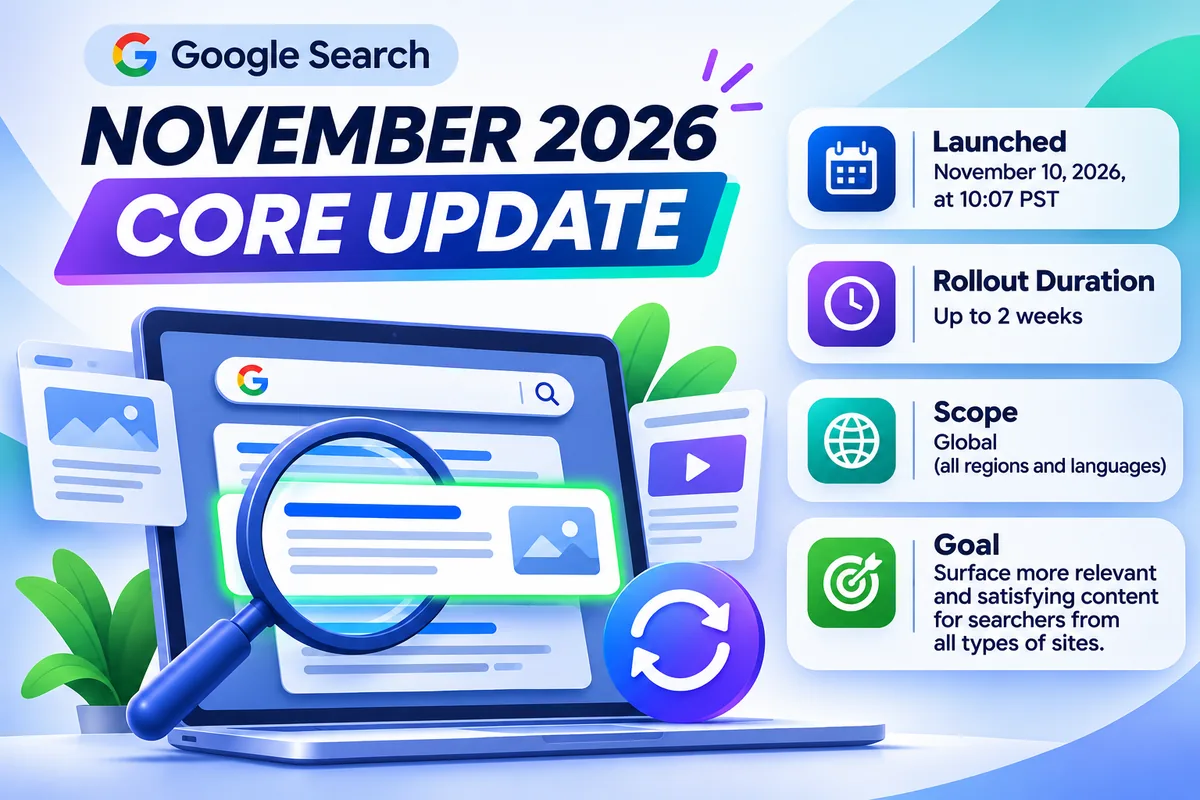
The infographic summarizes the known release window, worldwide scope, expected duration, and Google’s stated intent. At the time of preparation, the underlying timeline has not been updated with a confirmed completion. The illustration should therefore be read as an initial update snapshot, not as a post-rollout impact analysis.
Potential Implications for Publishers, Businesses, and SEO Teams
Organic traffic and search visibility may fluctuate
Clicks, impressions, average position, and click-through rate may shift throughout the rollout. A news publisher, an informational site, and a retailer are not necessarily affected in the same way. Query-level relevance and search intent are therefore useful review dimensions. They do not, however, establish that November 2026 introduced a newly named “intent factor.” Treat changes by page group, topic, market, and device rather than assuming a universal pattern.
Quality assessment should focus on real reader value
Site owners can use Google’s existing people-first content guidance to review the clarity, originality, accuracy, and usefulness of their work. Does a page answer the reader’s question? Does it distinguish firsthand information from sourced reporting? Can a visitor verify important claims? Are the author, sources, and publication context appropriately transparent? Our guide to Google E-E-A-T explores related quality considerations. E-E-A-T should not be misrepresented as a single numerical score that Google’s systems assign to every page.
Different Google surfaces require different reporting
A website’s overall organic traffic is not a substitute for segmented search data. Search Console can distinguish web, image, video, and news performance where available. Google Discover should be assessed in its own context rather than treated as identical to a conventional web search query. A change in one surface does not establish that every Google feature has moved in the same direction.
Smaller and independent publishers should avoid premature assumptions
Google’s wording refers to content from all types of sites, but it is not a guarantee that small publishers will gain rankings or that larger brands will lose them. Early “winner and loser” lists may reflect measurement choices, seasonal changes, or the markets sampled. Publishers should inspect their own query and landing page data before taking action, particularly when the rollout has not finished.
What Website Owners Should Do During the Rollout
1. Keep a clean record of timing and site changes
Annotate November 10, 2026 as the start date in your reporting notes. Keep a record of content updates, site migrations, template deployments, canonical changes, redirects, and server issues that occur nearby. A concurrent technical issue can distort any attempt to attribute traffic changes to the algorithm. Our guide to technical SEO describes several categories worth checking in a diagnostic review.
2. Avoid making conclusions from the middle of the rollout
Google recommends waiting at least one full week after a core update finishes before evaluating its impact through Search Console. The suggested comparison is a week after that period against a week before the rollout began. This provides a more stable baseline than comparing two individual days during active volatility. If the rollout lasts the full two weeks, the estimated endpoint may fall near November 24 Pacific time, but the official dashboard—not a calendar projection—should determine the final comparison dates.
3. Segment Search Console data carefully
Review your most important landing pages, branded versus nonbranded searches, top queries, and countries. Separate web search performance from other available search types. Compare rankings alongside impressions and clicks: a position decline with stable clicks may have a different business meaning from a sustained visibility loss affecting many commercial pages. Our Indonesian-language SEO reporting guide provides a practical framework, while our English article on free and paid SEO tools covers tools that can support routine monitoring.
4. Improve content where the evidence supports it
Prioritize factual corrections, outdated sources, confusing structure, unhelpful introductions, unsupported claims, and gaps that prevent readers from completing a task. Revisit navigation and relevant internal links, but avoid mechanical keyword repetition. On-page SEO fundamentals can guide editorial refinement without reducing it to a checklist of plugin scores. Useful updates are generally those that materially improve the page for its intended audience.
5. Be cautious about deletion and major sitewide changes
Google explicitly discourages quick fixes based solely on rumors. Removing content should be a last resort when it cannot realistically be improved. Large-scale deletions, rewriting hundreds of pages at once, or altering navigation purely because rankings moved for two days can obscure the underlying issue. In many cases a measured audit, followed by prioritized improvements, is more valuable than a reactive overhaul.
6. Monitor business outcomes rather than rankings alone
Revenue, qualified leads, subscriptions, and other business outcomes matter alongside visibility. A small change in informational queries may have little commercial impact, while a shift on a smaller set of high-intent pages may deserve urgent attention. Our English discussion of the consequences of overlooking SEO provides broader context for why organic search remains a strategic business channel.
Frequently Asked Questions
When did the November 2026 core update start?
The dashboard records November 10, 2026 at 10:06 a.m. PST as the incident start and 10:07 a.m. PST as the release entry.
Is the rollout worldwide?
Yes. Google’s dashboard says it applies globally and to all languages.
How long will the rollout take?
Google says up to two weeks. That is an estimate, not a confirmed completion date.
Is this a Google penalty?
No. Broad core updates are system-wide ranking changes, not automatic manual penalties for pages that lose positions.
Which ranking factors changed?
Google has not disclosed specific signal changes in the announcement covered here.
Will every website lose traffic?
No. Some sites may gain, some may lose, and many may see little measurable change.
Should I rewrite all my content immediately?
No. Begin with data, diagnose significant sustained changes, and make improvements that benefit readers.
When should I compare Search Console data?
Wait until the rollout is complete and then at least one full additional week. Use a pre-rollout week as a baseline.
Can rankings improve without another major announced core update?
Yes. Google states that its algorithms, including smaller core changes, are updated continually, and improvements do not necessarily need to wait for a future major release.
How can I follow the official status?
Use the Google Search Status Dashboard incident link in the references below, and check it for the confirmed end date.
Conclusion
Google’s November 2026 core update is a confirmed, worldwide ranking update that began on November 10 Pacific time. Google expects implementation to take up to two weeks and says the purpose is to surface relevant, satisfying content from all kinds of websites. As of this initial report, the company has not published a breakdown of new ranking signals or confirmed the finish of the rollout.
For businesses, creators, and SEO practitioners, the soundest next step is to monitor authoritative announcements, retain clear analytics baselines, investigate technical issues separately, and evaluate meaningful content improvements after enough data has accumulated. Rankings can change, but premature assumptions are rarely a substitute for careful evidence.
Official References
- Google Search Status Dashboard — November 2026 core update
- Google Search Central — Core updates and your website
- Google Search Central — Helpful, reliable, people-first content
Editorial note: this news article reflects the official status available as of November 11, 2026 (WIB) and should be updated once Google confirms completion.
