

1. Strategy and Execution
GoGolf’s digital strategy aimed to connect golfers with useful information across the journey, from learning about the sport and researching destinations to exploring golf courses and considering a booking. The focus was on a discoverable, connected website experience rather than publishing pages in isolation.
- Website development and optimisation: strengthen the links between course profiles, destination guides, educational content, and routes into GoGolf’s services.
- Search-intent-led SEO: improve the relevance and information structure of pages serving both branded and non-branded searches.
- Content marketing: build topic coverage that helps visitors understand golf, discover courses, and compare destinations.
- Multilingual SEO: support Indonesian and international landing page groups, with each market evaluated on its own trends.
- Analytics: use GSC and GA4 to evaluate search reach, audience growth, and engagement.
2. Overall Organic Search Performance — Google Search Console
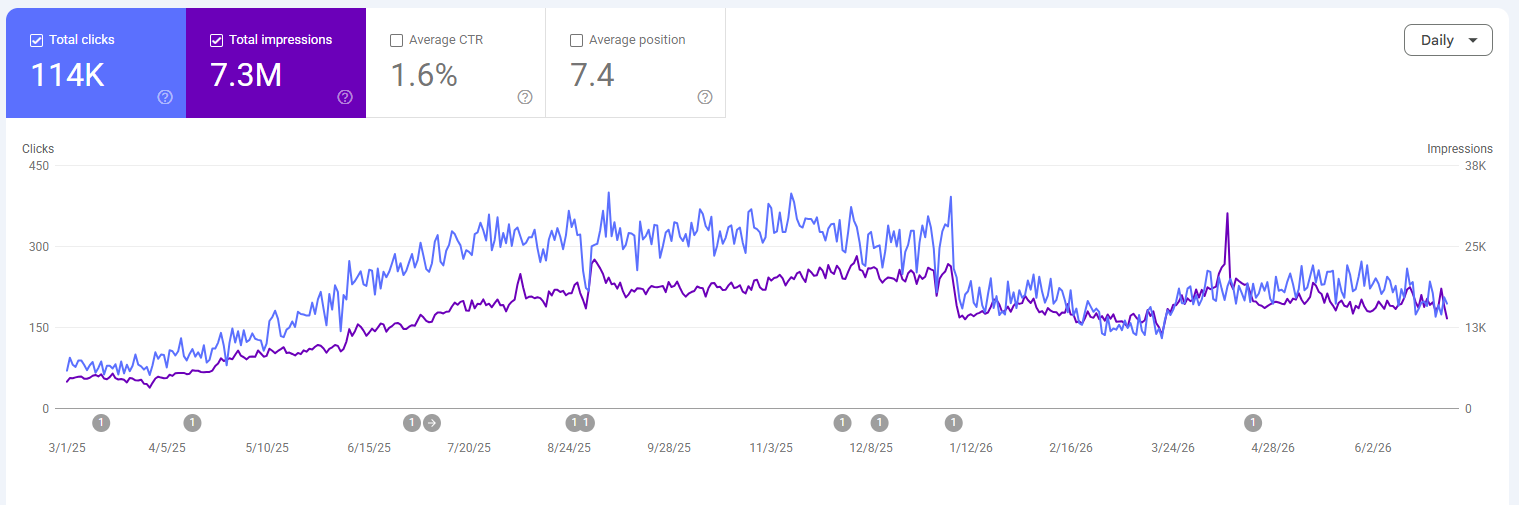
The report’s GSC dataset shows that GoGolf expanded its organic visibility from March 2025 through mid-2026. Growth accelerated during much of 2025, softened in early 2026, and showed a partial recovery from March 2026. The month-to-month trajectory was not uniformly upward.
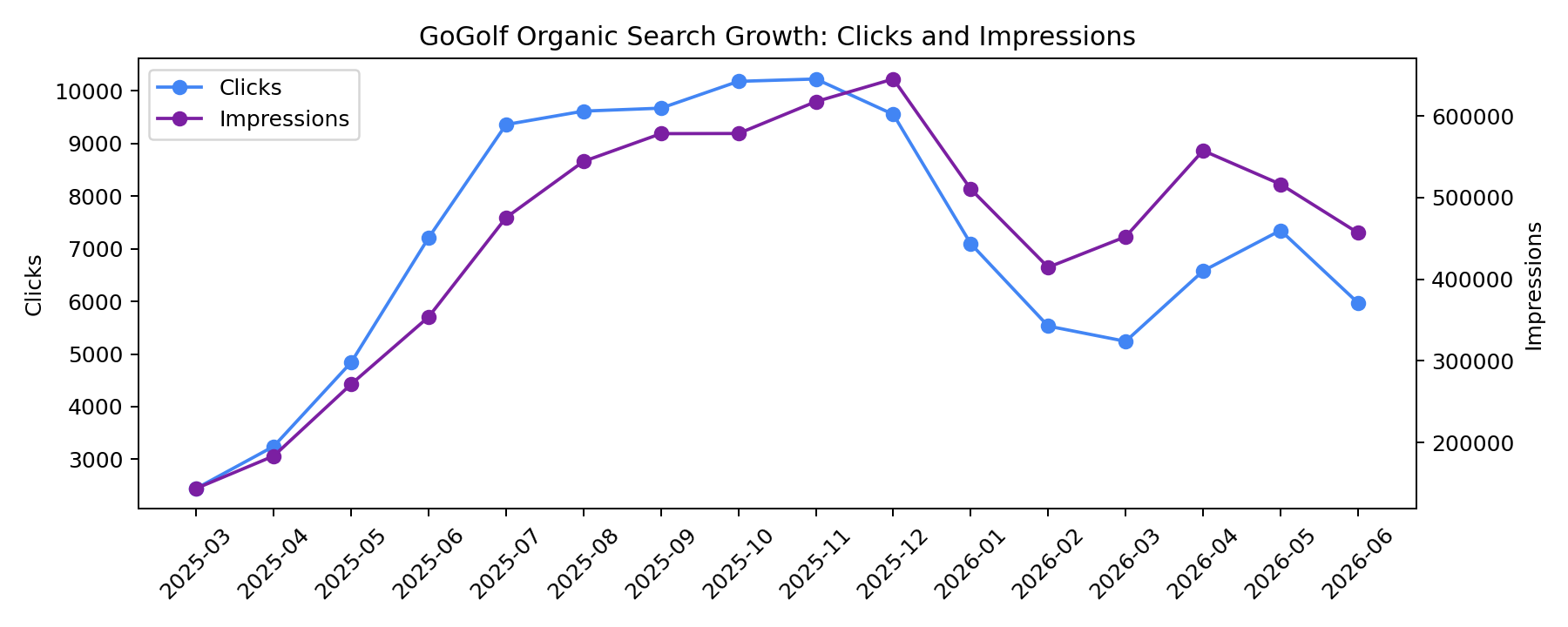
Growth interpretation: what do the numbers tell us?
The report compares March–June 2026 against the same four months in 2025:
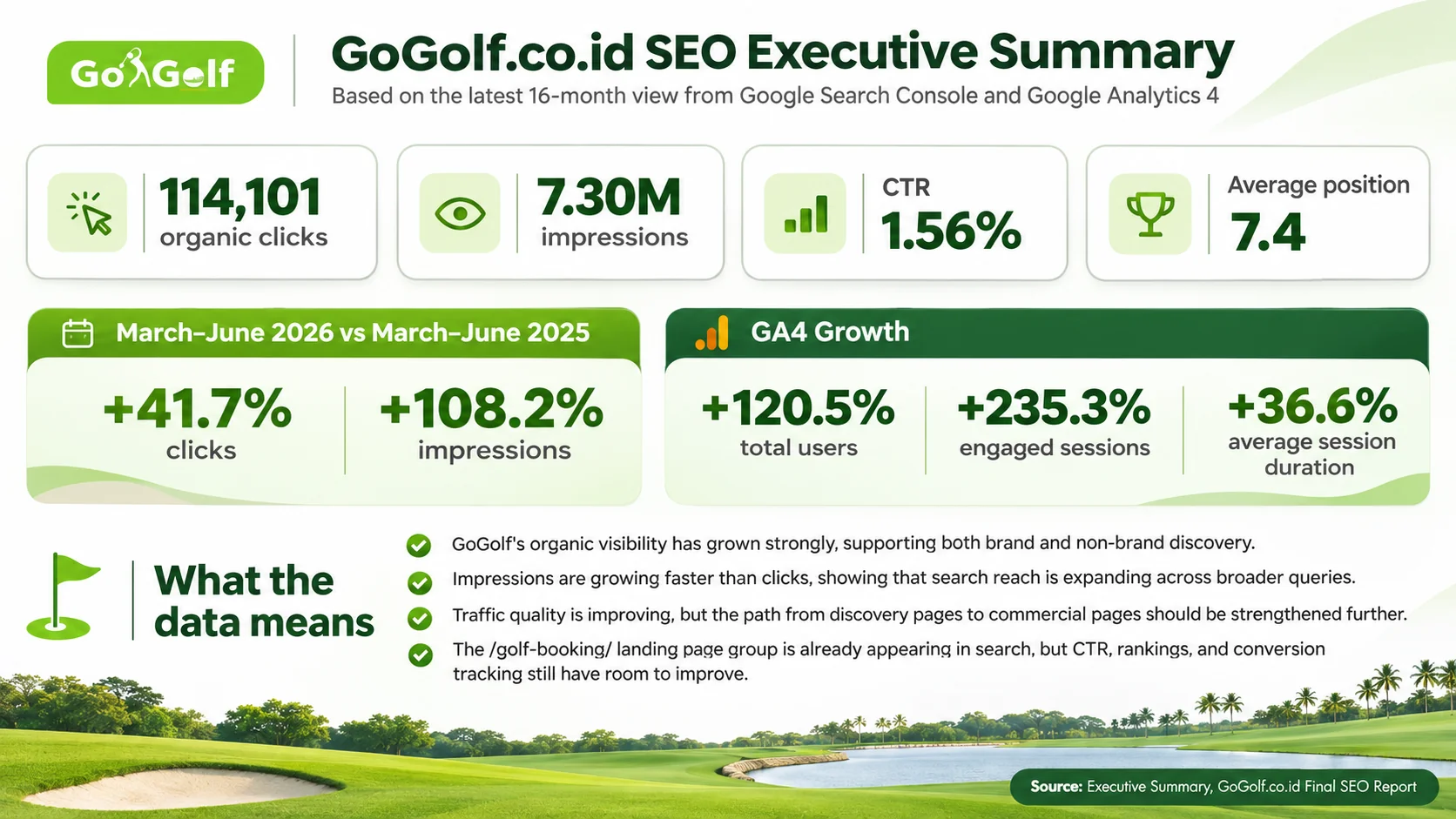
- Organic clicks: 25,139 versus 17,746, an increase of 41.7%.
- Organic impressions: approximately 1.98 million versus 952,419, up 108.2%.
- Average position: improved from 8.9 to 7.4 overall (a lower position number is better).
- Average CTR: shifted from 1.86% to 1.27%, as visibility expanded faster than clicks.
Interpretation: GoGolf appeared in a wider range of search results and gained more clicks in absolute terms. A falling CTR is not, by itself, proof of weaker SEO when impressions rise rapidly across broader informational or international search demand. It does, however, highlight an opportunity to refine titles, snippets, landing page relevance, and the match between search intent and on-page content.
3. GA4 Traffic and Engagement Performance
Google Analytics 4 adds a view of what visitors do after arriving on the website. The dashboard covers 30 June 2025–30 June 2026 against its previous comparison period. This is not the same reporting window as the GSC four-month year-on-year comparison above.
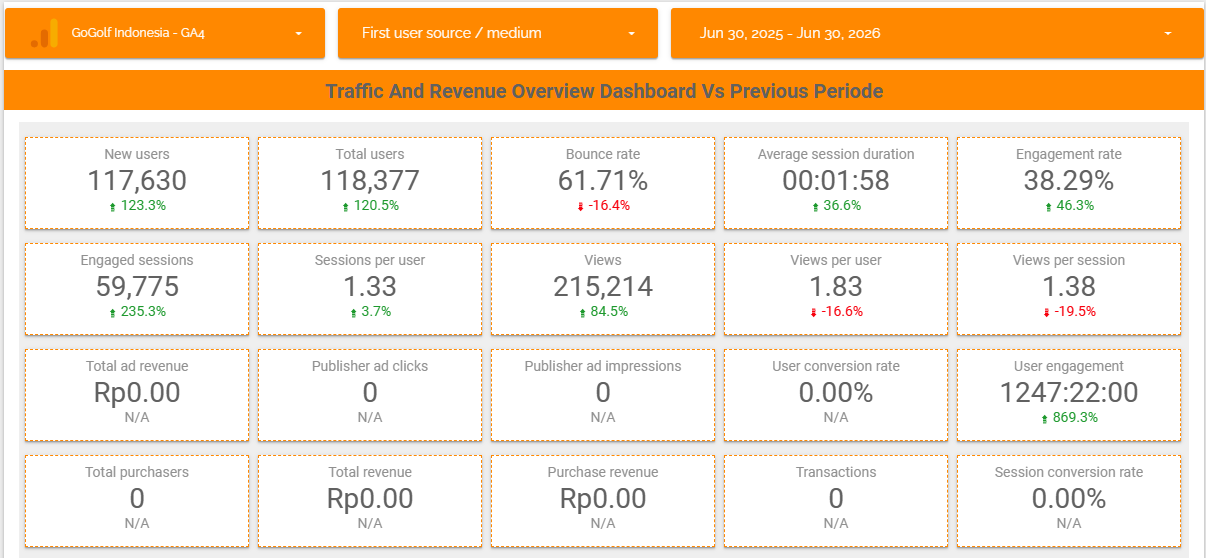
Key GA4 findings
- 118,377 total users, an increase of 120.5% versus the comparison period.
- 59,775 engaged sessions, up 235.3%.
- Engagement rate of 38.29%, up 46.3% in relative terms; average session duration was 1 minute 58 seconds, up 36.6%.
- 215,214 views, up 84.5%. However, views per user fell 16.6% and views per session declined 19.5%.
Interpretation: GoGolf attracted a larger, more engaged audience, but visitors did not necessarily explore more pages in each session. Educational content, course profiles, and destination pages therefore have an opportunity to guide users to their next step through contextual internal links, relevant course recommendations, and clearly placed course discovery or booking calls to action.
4. Performance by Language / Market Landing Page Group
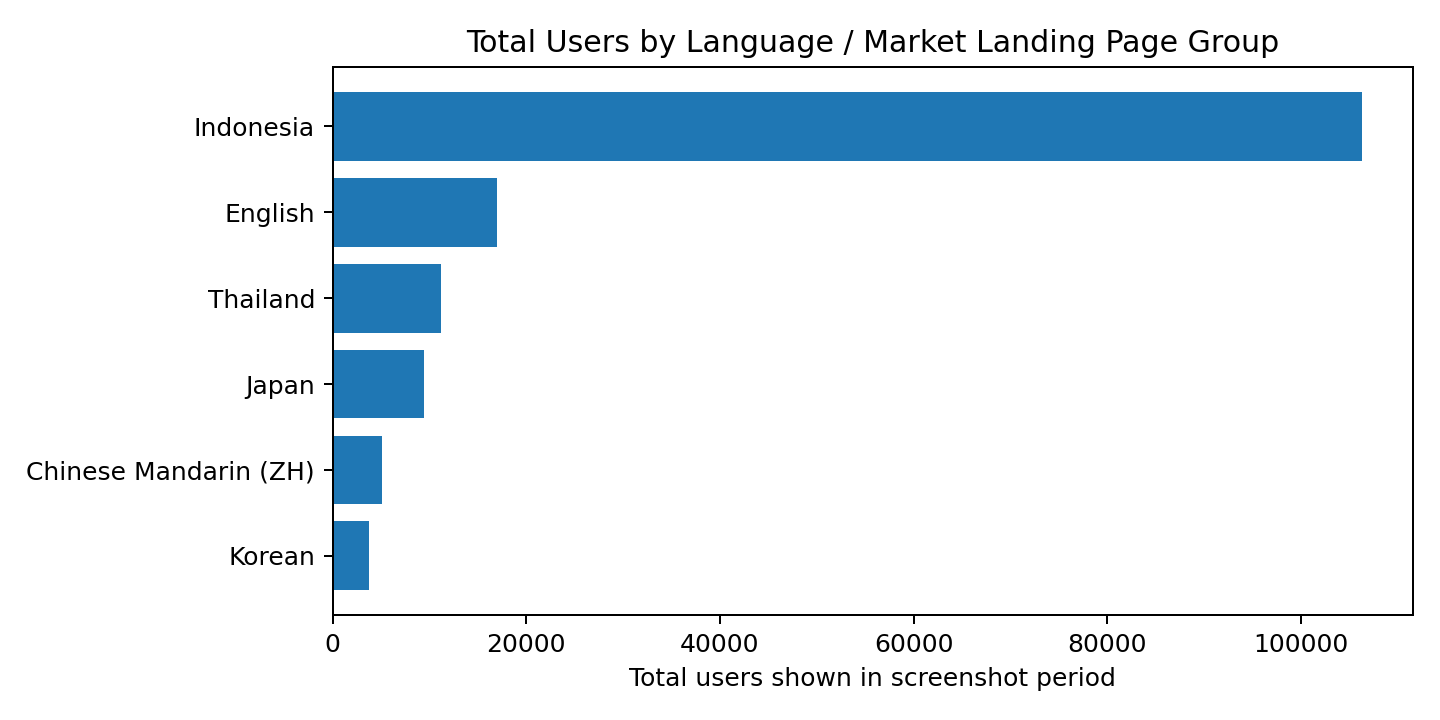
The language-group analysis shows that Indonesia remains the largest audience base, while English, Thailand, Japan, Chinese Mandarin, and Korean landing pages broaden GoGolf’s reach. These are page-language or market landing page groupings from the report, not proof of each visitor’s country of residence.
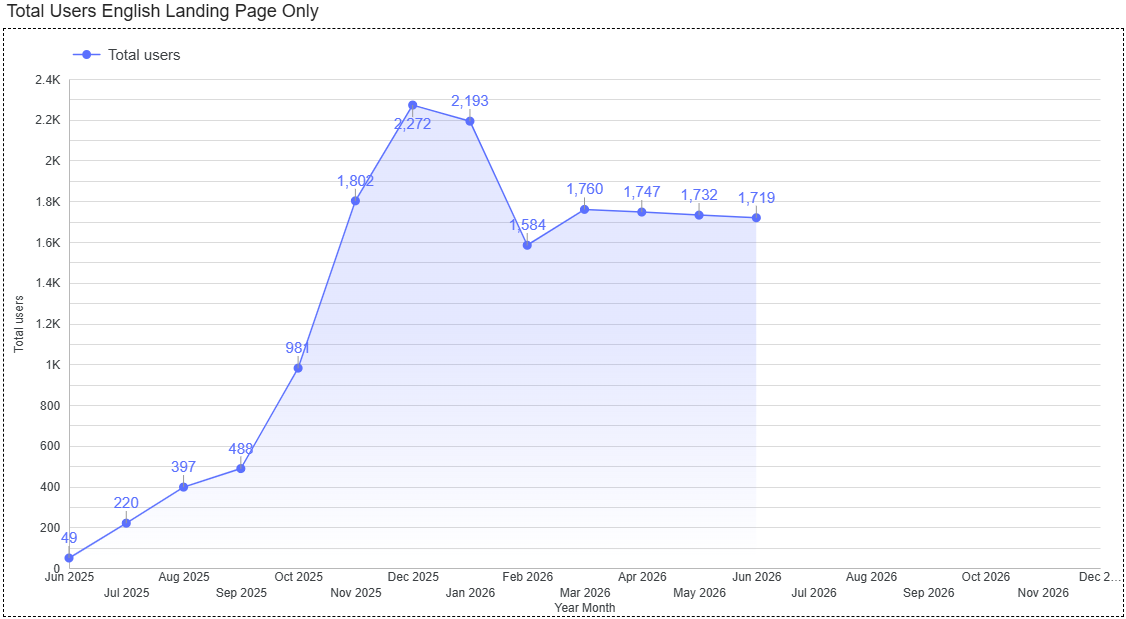
English landing pages: establishing a stronger recurring audience
English landing pages grew from a small starting point into a band of roughly 1,700–2,200 monthly users across several of the latest months displayed. The chart shows 1,719 users in June 2026. This is an encouraging demand signal for English-language content serving international golfers and travellers researching courses or destinations.
Japan landing pages: meaningful but fluctuating growth
The Japan landing page group also developed from a low base, reaching a visible peak of about 1,360 users in January 2026 and 978 users in June 2026. This pattern suggests that local relevance, seasonal demand, and ongoing content refresh should be assessed specifically for Japan rather than assuming that every international market follows one shared trend.
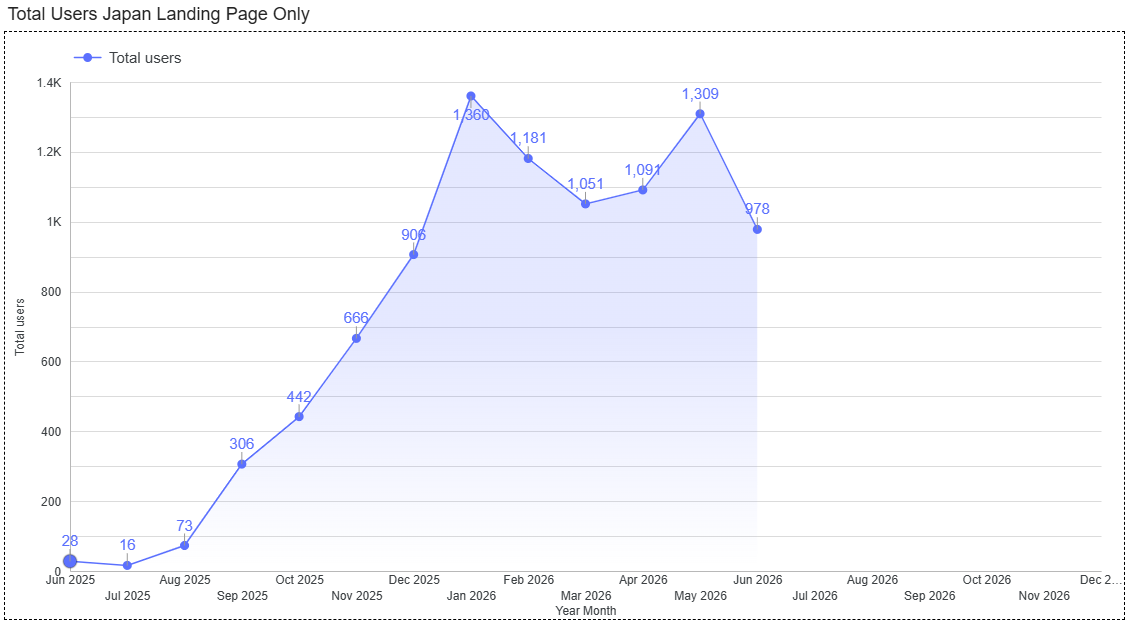
Market priorities: Indonesian pages remain the primary foundation. English and Japan pages warrant targeted refinement based on their respective audiences, while Thailand and Korean pages deserve review where their more recent performance has eased after earlier peaks. The data alone does not establish the exact cause of these changes.
5. Strategic Implications and Next Steps
- Improve organic CTR: strengthen titles, meta descriptions, and landing page relevance where impressions have expanded.
- Connect the user journey: link educational articles, course profiles, and destinations to appropriate course discovery and booking pathways.
- Optimise by market: review English, Japan, and other language groups according to their distinct demand patterns and search intent.
- Prioritise mobile usability: make course information, navigation, and calls to action easy to use on smaller screens.
- Strengthen business measurement: implement reliable events for booking steps, app downloads, and other relevant conversions.
6. Reporting Limitations
These figures document growth in organic search visibility, website audience, and engagement across the reporting windows stated above. The report does not establish how many bookings, transactions, app downloads, or revenue outcomes can be directly attributed to SEO. Those business results are therefore not presented as verified outcomes of this case study.
Source: Google Search Console, and Google Analytics 4. Images illustrate aggregated performance and do not disclose individual keyword or URL-level results.