

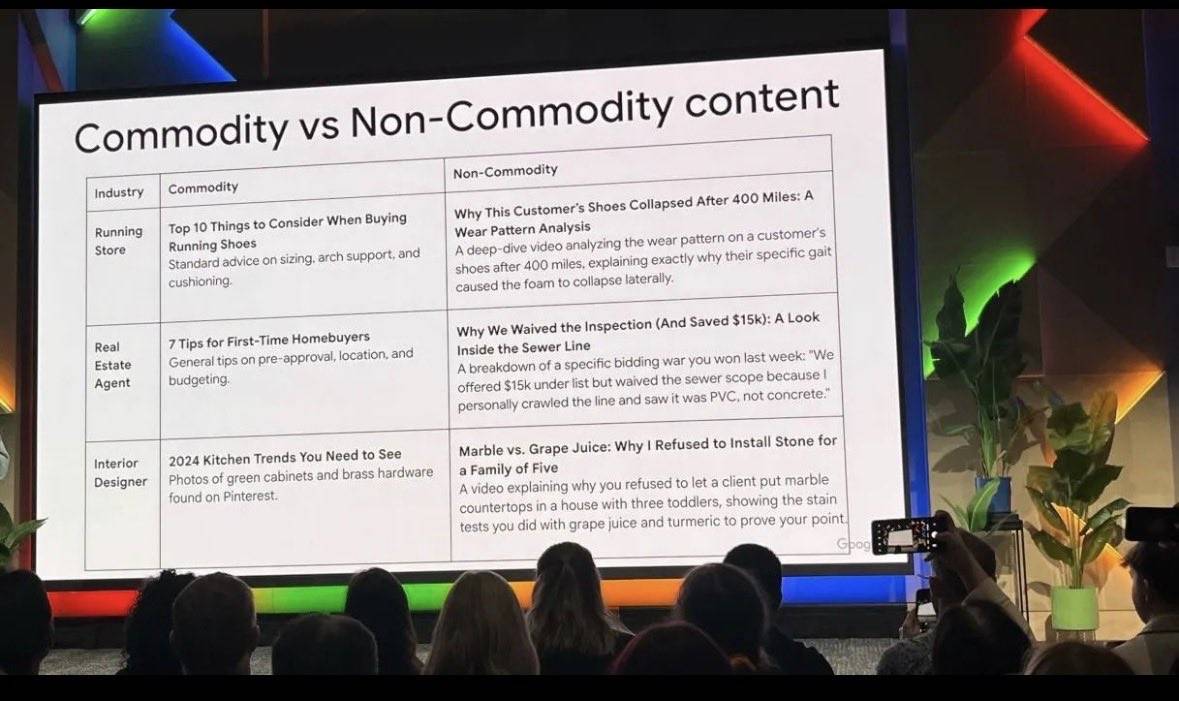
Commodity content is content whose information is easily found in a similar form in many sources, for example a general definition without additional analysis. Non-commodity content tries to offer something more difficult to exchange: direct research, data with clear provenance, relevant experience, testable methods, or analysis of decisions that explain rationale and limitations. This term is useful for editorial strategy, but is not an official Google ranking category.
In the era of AI search, generic answers are increasingly easy to summarize. Therefore, companies need to examine whether their content is truly helpful to readers once they understand the basics. This article compares the two types of content, includes examples of SEO and content marketing, and provides a rubric for selecting substantive updates without fabricating experiences or statistics.
What is Commodity Content?
Commodity content is content that contains general, shallow, easily interchangeable information with little distinguishing value. This type of content typically addresses topics only superficially: general definitions, generic tips, overly standard steps, or simply repeats what many other sites have already written without any new contributions. If ten websites publish nearly identical content, it’s highly likely that one, or even all of them, will appear to be commodity content.
The most common characteristics of commodity content include:
- only summarizes general information that is already widely circulated,
- does not demonstrate real experience or practical skills,
- did not give specific examples,
- have no clear opinion or analysis,
- easily rewritten by AI or competitors without losing the main meaning.
The problem is, commodity content doesn’t always mean “bad content.” Sometimes the writing is neat, the headings are correct, the keywords are well-placed, and the on-page SEO is even decent. However, because the main content doesn’t bring anything new to the table, these types of articles struggle to be considered top choices by users or search engines. Google explicitly advises creators to assess whether their content is truly created to help people, not just to rank.

What is Non-Commodity Content?
Non-commodity content is the opposite. This content carries value that cannot be easily transferred or duplicated by other sites. In Danny Sullivan’s summary of the presentation, non-commodity content is described by three main characteristics: unique or bring a point of view/information that is not easily imitated, specific or discuss concrete cases/situations, and authentic or demonstrate direct experience and expertise.
Translated into everyday practice, non-commodity content typically has one or more of the following elements:
- field experience,
- case study,
- internal data,
- experiment,
- clear expert opinion,
- real examples of clients, projects, or workflows,
- insights born from practice, not just the result of compilation.
Therefore, non-commodity content closely aligns with the principles of helpful, reliable, and people-first content. Google also states that to appear in AI features like AI Overviews and AI Mode, you don’t need special markup or AI files; all you need is a strong SEO foundation and genuinely helpful content.
You can, and should, create both types. And in fact, there is a need for both fresh commodity and non-commodity content.
Google is commoditising the most popular searches, it can be inferred. Don’t build a thin business on commodity content, and you won’t be CCU’d in the future… https://t.co/h2MaQIB06L
— Shaun Anderson (@Hobo_Web) April 23, 2026
Start auditing from search intent so that differentiation answers real questions.
Commodity Content vs Non-Commodity Content
In summary, the difference between the two can be seen like this.
| Aspect | Commodity Content | Non-Commodity Content |
|---|---|---|
| Core values | General information | Information + insight + differentiator |
| Viewpoint | Neutral and generic | Clear, specific, contextual |
| Depth | Surface | Deep and focused |
| Content source | Compilation of many similar articles | Experience, data, analysis, case studies |
| Ease of imitation | Very easy | Harder to replicate |
| Opportunities to survive in the AI search era | Tends to be weak | Stronger |
| Impact on brand | It’s hard to build authority | Helps build trust and authority |
It’s important to note that non-commodity content doesn’t always have to be long or complex. Even short articles can be non-commodity if they are highly specific, highly relevant, and provide insights not available elsewhere. Conversely, a 2,000-word article can still be commodity content if it simply rehashes a longer version of something everyone already knows.
Why Is This Topic Increasingly Important in the AI Search Era?
Google explains that AI Overviews and AI Mode help users understand complex topics, explore, and compare options more quickly. These systems can use a “query fan-out” technique, which runs multiple related searches across subtopics and data sources to compile comprehensive answers. This means that content that simply repeats common knowledge will be more easily discarded, because the system can find many similar versions at once.
On the other hand, Google also emphasizes that there are no specific technical optimizations for AI Overviews or AI Mode. The same SEO practices still apply: pages must be indexable, content must be helpful, and sites need good internal linking, a good page experience, and key information available in text form. In other words, the technical foundation remains important, but the quality and uniqueness of the content remain the differentiating factors.
For blog or business website owners, this means that content strategy can’t stop at “find keywords and write articles.” You still need keyword research, search intent, and on-page structure. But after that, you must ask: “What makes my article clickable, readable, and memorable?” Google itself advises creators to think about who created the content, how the content was created, and why the content was created.
Examples of Commodity Content and Its Non-Commodity Version
To make it easier to understand, here are some simple examples.
The basic understanding of SEO-friendly articles remains the foundation.
Example 1: SEO Topics
Commodity version:
“10 SEO Tips for New Websites”
This kind of title is very common. The content is usually predictable: keyword research, title tag optimization, backlink building, and so on. It’s not wrong, but it’s very easy to replace.
Non-commodity version:
“7 SEO Mistakes I Found While Auditing MSME Websites and How to Fix Them”
This version is stronger because:
- there is a real context,
- there is direct experience,
- there is a specific target reader,
- there is an opportunity to set an example that really helps.
Example 2: Content Writing Topics
Commodity version:
“How to Write SEO-Friendly Articles”
Non-commodity version:
“How I Turned a Generic Draft into a More Ranking-Worthy SEO-Friendly Article”
The second version opens up space to explain the process, editing checklist, before-and-after, and concrete editorial rationale.
Example 3: Content Calendar Topics
Commodity version:
“What Is a Content Calendar?”
Non-commodity version:
“The Content Calendar Template I Use to Plan 30 Article Ideas Without Running Out of Topics”
Here readers get not only definitions but also more practical context for use.
The trust factor can be understood through the concept of E-E-A-T.
How to Change Commodity Content to Non-Commodity Content
1. Start with search intent, but don’t stop there.
Keyword research remains important because it helps you understand the language users use and the topics they search for. However, keywords are just the starting point. Once you know your primary keywords, you need to clarify user intent, problems, and the types of answers they need most. To build on this foundation, you can deepen your understanding by reading our guide on how to create SEO-friendly articles and tips on creating SEO-friendly articles for content marketing.
2. Narrow down the discussion angle
Topics that are too broad tend to result in generic writing. The more specific the context, the greater the chance your article will be non-commodity. For example, instead of writing “how to optimize SEO,” you could write “how to optimize on-page SEO for service articles” or “how to optimize SEO for MSME websites that have only been live for 3 months.” Specific doesn’t mean narrow; specific means relevant and clear about who it helps.
Topic data can be mined through marketing research using SEO.
3. Add real experiences, observations, or workflows
This is one of the strongest differentiators. You don’t need to have a huge amount of data. Simple things like auditing experience, common error patterns, work templates, or editorial decisions you make can add value. If you’re writing about content writing, it’ll also be helpful for readers to explain the skills and work process of an SEO content writer or the requirements for becoming one.
4. Show the “why” behind your recommendations.
Many articles stop at the instructional level: do this, do that. Non-commodity content usually goes further, explaining why a step is important, when it’s effective, and when it’s not. This approach makes the content feel more expert and less like a compilation. Google itself emphasizes the importance of content that genuinely helps people understand a topic better.
Similar content that pursues similar intent can lead to keyword cannibalization.
5. Strengthen with proper on-page SEO
Unique content still requires a neat technical structure. Titles, meta descriptions, headings, internal links, URLs, and page experience still impact readability and discoverability. To do this, you can link readers to the article “10 Key Elements of On-Page SEO,” “The best on-page SEO strategies with examples,” or “Examples of on-page SEO optimization.” Google also cites internal linking as a best practice that remains relevant for AI features in Search.
6. Use data or research tools to enrich your point of view.
If you want your content to be editorially stronger, include data from research tools, frequently asked questions in SERPs, query patterns, or competitor gaps. For this stage, you can use Google Keyword Planner and structure your brief more neatly with a content brief template. If your workflow is planning-based, articles on what a content calendar is and examples of content calendars are also relevant to support the production process.
Checklist: Is Your Article Still Commodity Content?
Use the following questions before publishing:
- Could this article be written almost the same by 20 other websites?
- Am I just repeating the general definition?
- Are there any real examples that would really help the reader?
- Is there an opinion, analysis, or experience that makes this article unique?
- Will readers get something they wouldn’t get from a regular AI summary?
- Is my title too broad and generic?
- Does this article show who wrote it, how it was created, and why the recommendation is trustworthy?
If most of the answers are “not yet,” your article is still at risk of becoming commodity content.
The added value of technical guidance requires accurate technical SEO diagnosis.
Practical Strategies for Bloggers and Business Websites
If you manage your own blog, don’t rush to increase article volume before establishing a quality framework. It’s better to publish four specific, insightful, and internally interconnected articles than twenty generic articles with similar content. For a business website, focus each article on a genuine question from potential customers, then answer it using your experience, work process, and context. This approach is closer to people-first content and helps build topical authority.
If you use AI to assist with drafting, position it as a tool for acceleration, not a primary source of value. Google has made it clear that what matters isn’t whether you use AI, but whether the end result helps users and demonstrates adequate quality. So, while AI can speed up outlining, initial research, or refining language, the layers of insight, experience, and editorial decision-making must still come from you.
—
Commodity content can still generate occasional traffic, but it’s increasingly difficult to become a long-term asset. In an era where AI can quickly summarize general information, the most valuable content is content that has perspective, context, experience, and added value that can’t be easily replicated. That’s the essence of non-commodity content.
If you want articles that are stronger for SEO and more resilient to competition in AI search, don’t just ask, “What keywords should I target?” Also ask, “What can only I explain well?” That’s where truly readable content usually begins to take shape.
Reference:
- Google. “Creating Helpful, Reliable, People-First Content.” Google Search Central. Accessed April 24, 2026. (Google for Developers)
- Google. “SEO Starter Guide: The Basics.” Google Search Central. Accessed April 24, 2026. (Google for Developers)
- Google. “Top Ways to Ensure Your Content Performs Well in Google’s AI Experiences on Search.” Google Search Central Blog. Accessed April 24, 2026. (Google for Developers)
- Google. “AI Features and Your Website.” Google Search Central. Accessed April 24, 2026. (Google for Developers)
- Search Engine Roundtable. “Google On Not Publishing Commodity Content.” Search Engine Roundtable. Accessed April 24, 2026. (Search Engine Roundtable)
- Hobo. “What Is Non-Commodity Content? Meet The New Helpful Content.” Hobo Web. Accessed April 24, 2026. (Hobo)
Framework: Turning Generic Content Into a Hard-to-Replace Asset
1. Determine the practical problem behind the keyword
If a query asks “what is CTR,” definitions and formulas are widely available. Additional value can come from examples of CTR interpretation on different page types, measurement limitations, and rationale for selected actions. The page doesn’t need to be very long; the most valuable part can be comparing decisions with clear data sources.
The preferred framework should use data-driven marketing.
2. Add evidence that you actually have
Internal audits, authorized experiments, in-house developed template examples, and process documentation are all sources of differentiation. Don’t claim client results or experience that hasn’t been documented. If using illustrative figures, state that they were created to illustrate the method and not the results of a specific project.
3. Explain trade-offs and failures
An SEO strategy article that simply lists the benefits of each technique doesn’t help users prioritize. Include requirements, costs, risks, examples of when the strategy isn’t suitable, and how to prove it works. Honesty about limitations enhances the usefulness of the information.
| Topic | Commodity version | Non-commodity added value |
|---|---|---|
| Keyword research | Definition of volume and competition | Priority matrix and reviewable input data |
| Content calendar | Generic list of ideas | Work templates, task owners, effort estimates and evaluation evidence |
| Technical SEO | List of common errors | Decision tree diagnosis, impact and QA methods |
| Copywriting | Ten general tips | Before/after examples with clear assessment criteria |
Content Uniqueness Score: An Editorial Audit Tool, Not a Google Metric
Score 0–2 on four dimensions: depth of experience or evidence, clarity of methodology, accuracy of intent, and usefulness of examples. A total score of 0–8 only helps the team select content for enrichment, not the search engine formula. For example, an article with a complete definition (intent 2) but no method (0), examples (0), and evidence (0) has a working score of 2/8. The way to improve is to add tools and context, not simply to lengthen the text.
The presentation of findings can be strengthened with relevant data visualization.
Is Non-Commodity Content Sure to Win in AI Search?
There’s no guarantee that different content will be automatically cited in AI Overviews, AI Mode, or chatbots. Search engines use different signals and may choose different sources. Google encourages the creation of useful, user-centric content and prohibits scaled content abuse, which is created primarily to manipulate rankings without adding value. Therefore, don’t create hundreds of similar pages with definitions that are simply rehashed.
Evaluate changes based on reader concerns and trackable results. Non-commodity articles should also be free from factual errors, have adequate technical accessibility, good navigation, and clearly articulated content ownership. Review by industry-savvy editors is often a crucial quality control step before mass publication.
Frequently Asked Questions (FAQ)
1. What is commodity content?
Content whose answers and information are easy to find is similar in many sources.
2. What is non-commodity content?
Content with experience, data, methodology or contextual analysis that provides real differentiating value.
3. What are the terms non-commodity Google ranking factors?
No. That’s an editorial framework, not a factor name or official Google ranking guarantee.
4. Is definition content always bad?
No. A concise definition can fully satisfy a specific user intent.
5. Are long articles automatically non-commodity?
No. Length without new information can still be generic content.
6. What are examples of added value that can be tested?
Work checklists, templates, primary data, documented case studies and trade-off analysis.
7. Can experiences be created with AI?
Don’t make up client experiences or results that never happened.
8. How to audit old articles?
Check intent, evidence, clarity of process, real examples and usefulness of subsequent actions.
9. Does AI Search only cite unique content?
There are no simple rules or guarantees; quality, access and relevance remain paramount.
10. How to avoid content abuse?
Don’t produce a lot of unoriginal pages just to manipulate rankings.
11. Are keywords still important?
Yes to understand the audience’s language, but users need more meaningful answers.
12. How to measure the results of non-commodity content?
Assess quality engagement, conversions, referrals, and user problem solving.
