

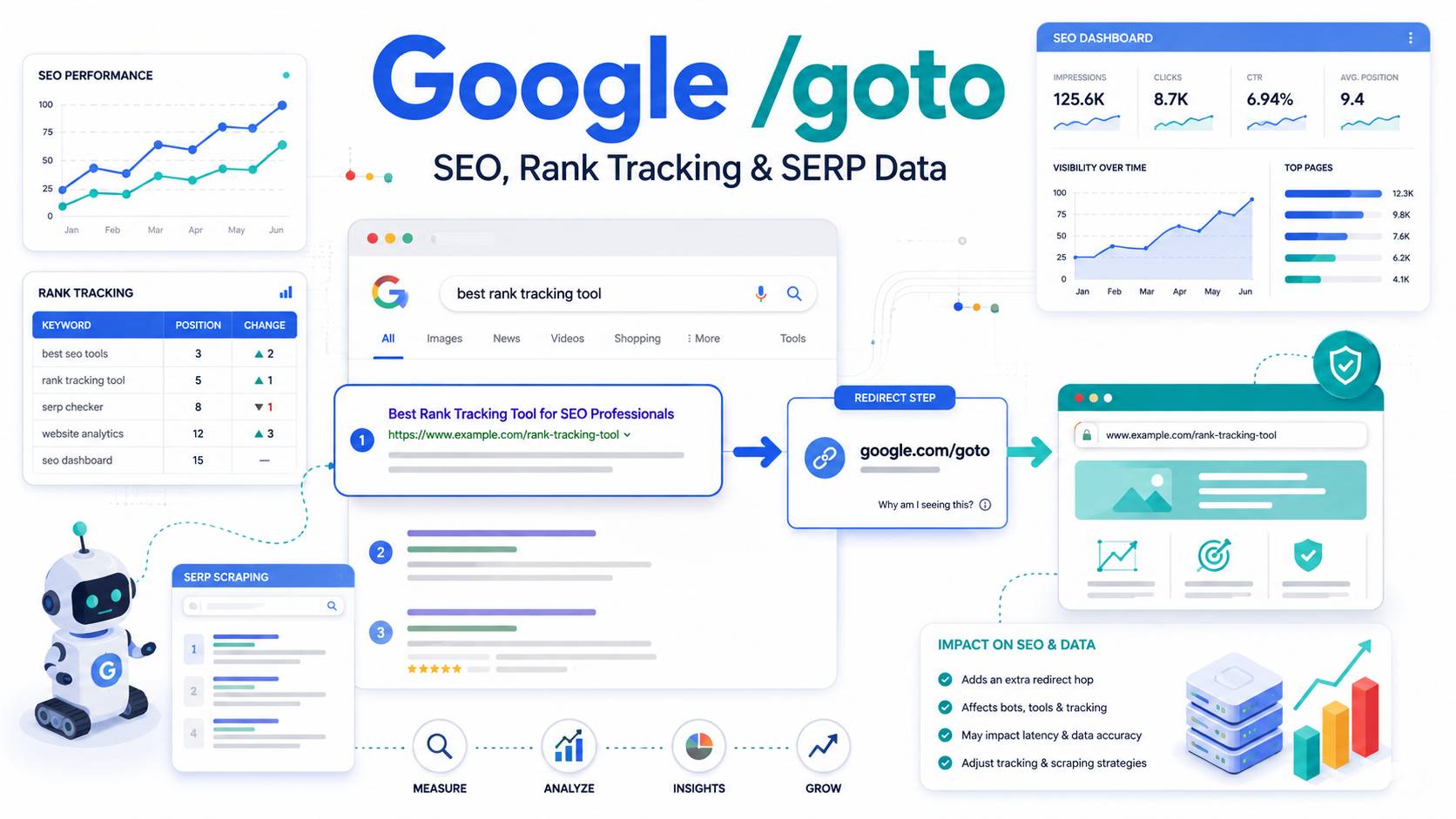
Google google.com/goto is a redirect intermediary that Google started using on some organic search result links in 2026. This change not a ranking algorithm update, but rather a technical change in how search result links are presented and forwarded. For the average user, the final destination remains the selected website. However, for SERP API vendors, rank trackers, and SEO data developers, the URL format change can disrupt how search engines identify the destination page.
Google confirmed the rollout of the mechanism on August 26, 2026. On November 5, Search Engine Journal also reported on the findings of two SERP data providers regarding link resolution speed restrictions. /gotoThis article explains what’s known, what vendor reports still tell us, and how to audit ranking anomalies without mistakenly concluding that a website is losing rankings.
Key Takeaways
- Google confirms rollout
google.com/gotoon August 26, 2026 as part of technical measures to address the ever-growing forms of abuse. - This change was not announced as a Google Core Update or ranking algorithm update.
- There is no indication that a website owner needs to change canonical, internal links, robots.txt, sitemap, or technical SEO configuration simply because of this.
/goto. - Rank trackers and SERP scrapers are potentially the most impacted because the destination URL is not always directly available from the result link.
- If not handled properly, domain matching, landing-page tracking, Share of Voice, competitor visibility, and historical ranking data can become inaccurate.
- SISTRIX, DemandSphere, SerpApi, and DataForSEO have already made or announced adjustments to the changes.
- Google Search Console becomes an important benchmark when third-party rank tracker data looks abnormal.
- In the long term, this change has the potential to increase the cost of collecting SERP data at scale.

What is Google google.com/goto?
Simply, google.com/goto A passthrough or redirect URL is a URL that exists between Google search results and the destination website.
Previously, the flow of an organic result conceptually looked like this:
Google SERP → https://example.com/halaman/
With the new mechanism, the flow could be:
Google SERP → google.com/goto?... → https://example.com/halaman/
For humans clicking on search results, the difference is relatively small. Google still directs users to the selected page.
But for software that automatically reads the SERP HTML, the change is more significant.
Previously, a scraper could read the result link and immediately learn several key pieces of information:
- ranking domains;
- URL or landing page that ranks;
- the position of the page in the SERP;
- as well as other attributes such as title and snippet.
Now, the href found by the software can first point to Google, instead of directly to the destination URL.
Google Was Already Testing /goto Before This Rollout
This phenomenon did not actually appear suddenly in late August 2026.
The Search Engine Roundtable previously reported on testing google.com/goto in July 2026 after a number of SEO practitioners began seeing link results redirected through Google. During the testing phase, the implementation was not yet consistent across all users and requests.
The situation became more critical on August 26, 2026, when Google confirmed that the change was indeed being rolled out more broadly.
Google stated that the company has a long history of using technical measures to address evolving forms of abuse and routinely takes steps to protect its services and users.
However, Google does not specifically say that rank trackers, SERP API providers, SEO tools, or AI companies are the primary targets of this change..
Therefore, we need to distinguish two things:
- Confirmed facts: Google is doing a rollout
/gotoand link it to technical measures against abuse. - Industry interpretation: These changes technically make automated SERP collection and scraping more difficult or expensive.
According to Bloggerpi Digital, this distinction is important. We shouldn’t turn technical observations into unconfirmed claims about Google’s motivations.
Does google.com/goto Impact SEO Ranking?
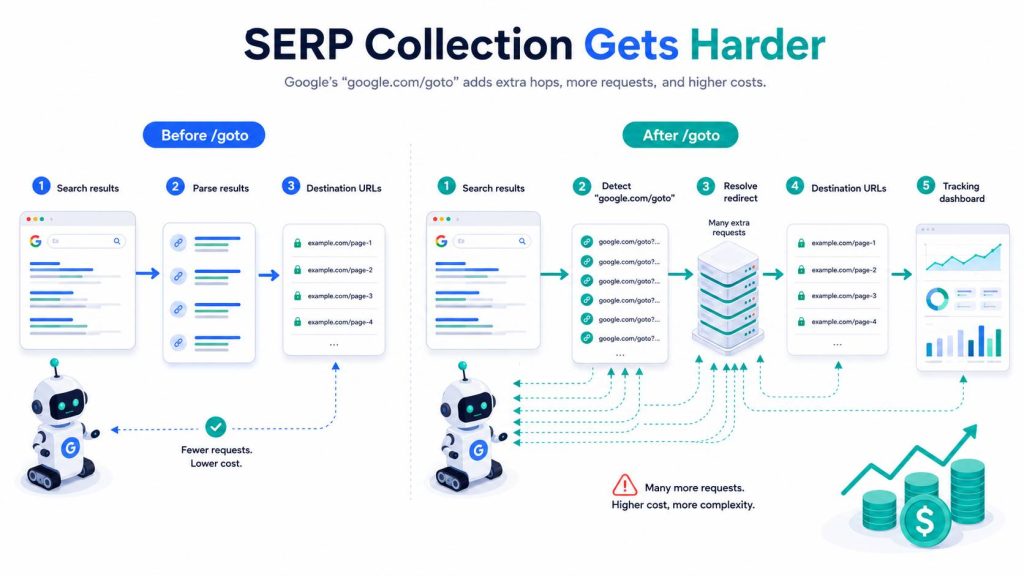
For now, there is no evidence that the use of /goto changing the way Google determines page rankings.
The changes are also different from Google algorithm update that can change how Google’s systems evaluate, understand, or rank pages.
The website page remains the page that Google indexes. The destination URL remains the page the user ultimately visits.
In other words, Google is adding a step to the click path in Search, not replacing your destination page with a new page. google.com/goto in the index.
Therefore, there’s no reason to rush into changing it:
- canonical URL;
- redirect website;
- XML sitemap;
- robots.txt;
- internal linking;
- URL structure;
- or on-page optimization.
The foundations of technical SEO remain the same: a website must be crawlable, renderable, indexable, have a clear structure, and provide a good user experience.
If a website experiences a ranking drop during the same period, don’t immediately conclude that google.com/goto is the cause.
Google rankings are influenced by many factors. Therefore, analysis should still look at website data and factors that influence Google Search rankings more broadly.
SEO Hasn’t Changed Much, But How We Measure SEO Could Change
This, according to Bloggerpi Digital, is the most important part of the whole /goto story.
We need to distinguish between:
SEO performance
and:
SEO performance measurement
A website can remain ranked at the same position while a third-party tool fails to identify the ranking domain or URL.
As a result, the dashboard can appear as if SEO performance has changed, when in fact the problem lies in the data collection layer.
| Area | Potential Impact |
|---|---|
| Google ranking algorithm | No indication of impact |
| Website indexing | No indication of impact |
| Canonicalization | No indication of impact |
| Googlebot crawling website | No indication of impact impacted |
| Google Search Console | Relatively low risk due to using first-party Google data |
| GA4 organic reporting | No evidence of widespread disruption yet, but still worth monitoring |
| Rank tracker | Potentially high impact |
| SERP API | Potentially high impact |
| Custom SERP scraper | Potentially very high impact if the parser is not yet Updated |
| Share of Voice and competitor monitoring | Can be impacted if the destination URL fails to resolve |
Why Are Rank Trackers and SERP Scrapers Most Impacted?
Many SEO tools build part of their databases by observing search results on a very large scale.
Imagine a system wants to know who ranks for the keyword:
best seo agency indonesia
The system retrieves the SERP, reads each result, and then stores information such as:
- position;
- domain;
- ranking URL;
- title;
- snippet;
- SERP feature;
- and timestamp.
Previously, the destination URL could often be read directly from the result link.
If the available URL is now in the form google.com/goto, the scraper has one additional job: finding out the actual destination URL.
1. Destination URL Can No Longer Always Be Assumed to Be in href
For example, the first to third positions are actually occupied by:
domain-a.com
domain-b.com
domain-c.com
A simple parser that simply retrieves the hostname from the href could potentially read:
google.com
google.com
google.com
Google Search still works correctly.
However, the dataset the scraper built is incorrect.
2. Domain Matching Can Fail
Rank tracking requires domain matching to determine whether a result is the website being monitored.
If the destination URL cannot be successfully resolved, the system may have difficulty answering basic questions such as:
Does example.com rank on this keyword?
These issues can then impact other metrics built on top of ranking data.
3. Share of Voice and Competitor Visibility Can Be Inaccurate
This is very relevant to competitor analysis.
SEO platforms typically calculate visibility based on a combination of ranking position, search demand, and the domains occupying each position.
If the domains are not successfully identified, the attribution is also likely to fail.
DemandSphere explains that implementations that do not handle /goto properly can result in several problems such as:
- destination URL which reads as Google URL;
- domain matching failed;
- Inaccurate Share of Voice;
- incorrect competitor attribution;
- and historical series that appear to be disconnected.
4. Landing-Page Tracking and Cannibalization Analysis Can Be Disrupted
SEO specialists don’t just want to know a domain’s ranking.
We usually also need to know which page the ranking.
For example:
/seo-services/
suddenly replaced by Google by:
/seo-guide/
Changes like this can indicate keyword cannibalization, a change in search intent, or Google choosing a different landing page.
If the destination URL is not successfully read, these insights can be lost.
5. Historical Ranking Series Can Appear to Be in Decline
This is one of the most significant risks from an SEO reporting perspective.
Imagine a dashboard showing:
24 Aug: Visibility 18%
25 Aug: Visibility 18.2%
26 Aug: Visibility 12%
27 Aug: Visibility 9%
The first reaction might be:
Is the website updated?
However, it’s possible that actual rankings remain relatively stable while providers lose the ability to attribute some results to the correct domain.
Therefore, changes in methodology and data collection must be considered when conducting SEO reporting.
One SERP Can Now Require More Requests
This is where the economic impact begins to emerge.
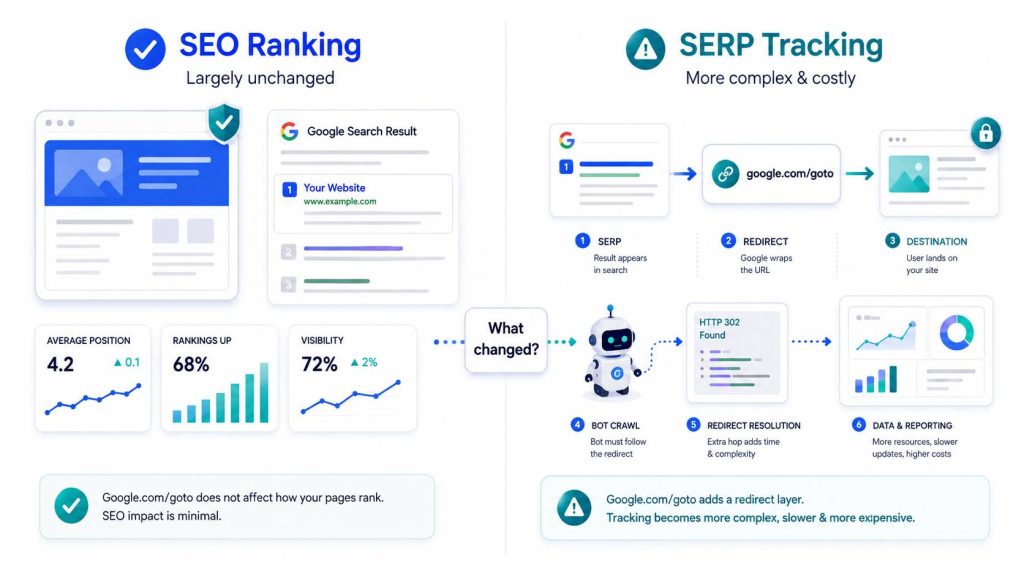
The previously simple workflow could be described as:
Fetch SERP → Parse Results → Extract Destination URLs
With /goto, the process can change to:
Fetch SERP → Parse Results → Identify /goto Links → Resolve Destination → Store Final URLs
SISTRIX explained that each masked URL they resolve requires an additional request to Google. According to the company, this change makes collection more complex and more expensive.
Nozzle also reported significant additional request overhead in deep rank tracking. PPC Land quoted Nozzle estimates of around 500 to 1,000 requests for some scenarios collecting five pages of search results.
These figures should not be interpreted as a rule that every keyword now always requires 1,000 requests.
These are estimates for specific workflows.
But the direction of change is clear:
Getting the final destination URL from the SERP can require more work than before.
The Impact Becomes Greater When Multiplied by Millions of Keywords
One additional request may seem insignificant.
Problems arise when a provider monitors:
- millions of keywords;
- many countries;
- thousands of locations;
- desktop and mobile;
- multiple languages;
- and refreshes daily.
A small additional process on a single SERP can translate into millions or even hundreds of millions of additional operations when performed at an enterprise scale.
Infrastructure such as proxy servers, request orchestration, retry handling, parsing, and distributed data collection become increasingly important in this process.
However, /goto shows that the challenge now goes beyond simply getting a Google Search page.
Providers must also ensure that each result can be correctly mapped back to the destination website.
This Problem Came After Changing num=100
The larger context is also important.
In 2025, Google’s change to the use of the num=100 parameter made deep SERP collection less efficient for many rank trackers and data providers.
Whereas previously a provider could retrieve a larger set of results with fewer requests, deep ranking collection now requires pagination and additional requests.
/goto now potentially adds cost at a different stage: destination URL resolution.
The combination can be simply seen as:
lebih banyak request untuk mengambil deep SERP + lebih banyak pekerjaan untuk mengetahui final destination URL.
According to Bloggerpi Digital, the pattern of these changes is more important than viewing /goto as a standalone feature.
SERP Tracking Vendors Have Started to Adapt
The good news is, rank tracking won’t stop working immediately.
Several providers have already revealed how they are handling the change.
| Provider | Response |
|---|---|
| SISTRIX | Resolved masked URLs and explained that each resolution requires an additional Google request. |
| DemandSphere | Sayed their organic ranking data was handled and explained the risks to domain matching, Share of Voice, and historical series if /goto was not resolved correctly. |
| SerpApi | Noted a fix for cases where the API returned unresolved /goto URLs instead of final ones. destination. |
| DataForSEO | States that it has implemented destination resolution for almost all standard organic results, with some edge cases being more prevalent in certain SERP features. |
Large SEO platforms likely have sufficient engineering resources to adapt.
Platforms like Ahrefs and other enterprise providers also have a significant incentive to maintain the quality of their ranking data.
The long-term question isn’t whether the industry can adapt.
The question is:
What is the additional cost of maintaining the same data quality?
What are the Long-Term Impacts for SEO Tools?
If the cost of SERP data collection continues to rise, there are several possibilities worth considering.
Ranking Refresh Could Become Slower
Additional network requests and processing can increase the time required to generate a complete ranking dataset.
Deep Rank Tracking Could Become More Expensive
Extracting the top 10 is much cheaper than reconstructing the top 100 for millions of keywords.
Therefore, deep ranking data can become increasingly expensive to produce.
Sampling Could Be Increased
Providers can choose to perform high-frequency tracking only for important keywords, while other datasets use a lower sampling or refresh frequency.
SERP API Prices Could Experience Upward Pressure
If generating a complete SERP requires more network and computing resources, these costs can ultimately impact pricing or credit consumption.
Smaller Providers Could Face Greater Pressure
Enterprise providers have larger infrastructure, engineering teams, and budgets to respond to Google’s changes.
Small custom scripts or low-cost rank trackers may not have the same resources.
In the long term, this has the potential to cause high-quality SERP data to become increasingly concentrated among providers with large infrastructure.
However, it should be emphasized that the points above represent potential economic impacts, not announcements that specific vendors will definitely raise prices or reduce tracking depth.
Custom SERP Scrapers Also Need to be Checked
If you have an internal script with logic like:
read href → extract hostname → compare domain
This assumption now needs to be retested.
The problem isn’t limited to rank tracking either.
SERP data is often used as input for:
- keyword clustering based on SERP overlap;
- search intent classification;
- competitor discovery;
- cannibalization detection;
- organic Share of Voice;
- URL similarity analysis;
- SERP feature monitoring;
- content gap analysis;
- and AI-search research.
For example, a keyword clustering algorithm can determine that two keywords have the same intent if seven out of ten ranking URLs are the same.
If the destination URL cannot be identified, the clustering system is missing one of its key inputs.
For teams developing their own tools, a healthier response is to evaluate the dependencies, methodologies, and data sources used rather than simply adding techniques to circumvent Google’s anti-bot mechanisms.
November 2026 Update: /goto URL Lookup Restrictions
On November 5, 2026, Search Engine Journal reported that DataForSEO and Serper discovered a limitation on how fast redirects can be google.com/goto can be followed on a single search results page. As a result, some data retrieval modes may potentially store Google’s intermediary URLs instead of the intended destination URL. This is vendor experience report, not an official API specification or a statement that all Search users are impacted.
It’s important to distinguish between three situations: rank tracker data suddenly failing to resolve URLs, website pages being completely inaccessible to users, and SERP positions actually changing due to competition. The first situation doesn’t automatically prove the third. Therefore, SEO dashboards should store indicators of data collection quality and provider status, not just numerical rankings.
Checklist for teams purchasing data from SERP API
| Inspection | Symptoms of the problem | Suggested steps |
|---|---|---|
| Destination URL resolution | The URL field contains google.com/goto | Confirmation of methodology and provider support |
| Domain matching | Competitor pages appear to be missing from the data | Audit mapping and unresolved data |
| Ranking history | Mass drop without change in Search Console clicks | Compare collection changes and manual samples |
| Fees and quotas | Additional requests and latency increase | Review vendor limits and measurement scales |
| Website traffic | Clicks and engagement changed significantly | Perform a separate SEO audit |
If the report from Google core update case study or spam update history If used to explain ranking changes, first check whether the data collection interruption date coincides with the launch period. The two are not the same phenomenon.
How to maintain the integrity of historical SEO data?
Save the raw record from the provider, the resolved destination, if applicable, the collection date, the collection method, and any markers when the provider changes parsing. Don’t fill in blank data with a zero ranking without indicating that the actual result was not processed successfully. Drops in the table from parser errors should be separated from drops in organic visibility.
To strengthen the measurement, use keyword cannibalization analysis based on the original URL and check indexing status If there are changes to the website page, comparing two data sources with different definitions must be accompanied by a methodological explanation.
What about Google Search Console?
This is where first-party data becomes increasingly important.
Google Search Console doesn’t need to reconstruct public SERPs using the same methods as third-party scrapers.
Performance reports come from Google’s own systems and provide data such as:
- clicks;
- impressions;
- CTR;
- average position;
- query;
- and landing page.
Bloggerpi previously also discussed how Google Search Console can be used for keyword evaluation because the data comes from the website’s actual search performance.
There is no indication that the rollout will be effective. /goto corrupting the Search Console Performance report.
Therefore, when the rank tracker shows extreme changes while GSC remains relatively stable, the discrepancy should be a trigger for investigation.
For example:
| Data | Observation |
|---|---|
| Third-party visibility | Down 35% |
| GSC impressions | Relatively flat |
| GSC clicks | Relatively flat |
| Organic conversions | Relatively flat |
This condition does not automatically prove the rank tracker is wrong.
However, before concluding that SEO loss has occurred, check for possible collection issues or methodology changes first.
What about GA4 and Organic Attribution?
Currently, there is no evidence of widespread disruption to Google Analytics organic attribution due to the /goto rollout.
Users still end up on the destination website.
However, analytics teams using custom referrer logic, server logs, or proprietary attribution should continue to monitor data after the rollout.
Some signals worth paying attention to:
google / organicsessions;- Unusual changes in Direct traffic;
- raw referrer values;
- landing-page attribution;
- and custom tracking pipelines.
This approach also aligns with the principles of digital marketing analytics: don’t read one metric in isolation, but look at the relationship between acquisition, visibility, behavior, and conversion.
What Should the SEO Team Do Now?
There’s no need to panic and there’s no need to make website migrations or technical changes just because Google uses /goto.
What needs to be checked is the measurement layer.
1. Add annotation for the date August 26, 2026
Add a note to your SEO reporting, Looker Studio, dashboard, or data warehouse:
26 Aug 2026 — Google confirms broader rollout of google.com/goto passthrough URLs in Search.
This way, if the historical series changes around that date, the team has additional context when analyzing.
2. Compare Rank Tracker with First-Party Data
Don’t analyze rankings in isolation.
Compare with:
- GSC clicks;
- GSC impressions;
- average position;
- organic sessions;
- conversions;
- leads;
- and revenue, if available.
3. Check if the Provider Supports /goto
If using a rank tracker or SERP API, check the provider’s changelog and status.
Questions you can ask include:
- Has the final destination URL been successfully resolved for standard organic results?
- What about SERP features?
- What about AI Overviews?
- Are historical datasets still comparable?
- Has the refresh frequency changed?
4. Audit a Sample of the Most Important Keywords
There’s no need to manually check every keyword.
Take a sample of keywords with high commercial value and compare:
- domain ranking;
- position;
- landing page;
- and SERP features.
A small sample is enough to detect anomalies in provider data.
5. Don’t Immediately Assume a Visibility Drop as a Ranking Drop
Third-party SEO tools remain very useful, especially for competitor intelligence not available in Search Console.
However, all third-party visibility metrics are essentially derived from their respective provider’s observations, databases, and modeling.
If the way Google presents search results changes, the methodology of these tools may also need to change.
Checklist If Rank Tracker Suddenly Shows Strange Data
| Signal | What to Check? |
|---|---|
| Many keywords suddenly become “Not Found” | Check provider status and support for /goto. |
| Visibility drops but GSC is stable | Validate a sample SERP and check for collection issues. |
| Ranking URL appears as google.com | The tool may not have performed final destination resolution with Correct. |
| Competitor Share of Voice suddenly disappeared | Check domain matching. |
| Historical graph was broken around August 26–27 | Check methodology or collection changes from the provider. |
| SERP API is becoming slower | Check the vendor’s changelog and status page. |
| Organic traffic and conversions are significantly down | Perform your usual SEO diagnostics and don’t automatically blame /goto. |
Bigger Picture: Google Search Engines Are Becoming More Expensive to Reconstruct
According to Bloggerpi Digital, this is actually the most interesting part of this development.
/goto doesn’t require “turning off the rank tracker” to have a big impact.
Simply increasing the cost per observation is enough.
If a provider previously required multiple requests to get rankings and destination URLs, and now requires additional resolution, the economics of SERP data collection change.
Multiply that additional work by:
- millions of keywords;
- dozens of countries;
- desktop and mobile;
- thousands of locations;
- daily refresh;
- and various SERP features.
The scale becomes enormous.
This change also occurs as the SEO ecosystem adapts to AI Overviews, AI Mode, increasingly zero-click experiences, and various latest SEO trends.
Therefore, there’s an increasingly interesting pattern to observe:
Google Search remains easy for humans to use, but increasingly expensive and complex for machines to fully reconstruct at scale.
Rank tracking likely won’t disappear.
However, high-quality SERP data may become more expensive, more heavily processed, and increasingly dependent on providers with robust infrastructure.
Recommendation for SEO Teams: Check Measurements Before Changing Strategy
The google.com/goto rollout is certainly worth noting, but it doesn’t mean the website needs new optimization.
For now, there’s no reason to view it as a ranking update.
The foundation of SEO remains the same: create a website that is crawlable, indexable, relevant, fast, easy to use, and truly helpful to users.
What needs more attention is the measurement layer.
Rank trackers, SERP APIs, competitor visibility platforms, keyword clustering tools, and custom scrapers must ensure they continue to correctly identify destination URLs.
For SEO specialists, the most important lesson is quite simple:
Don’t make major decisions based on just one metric or one data provider.
Use Google Search Console as a first-party benchmark, validate major changes using multiple data sources, and always check whether changes in the dashboard originate from the website or from the way the tool collects data.
Because sometimes it’s not our rankings that change.
What changes is how those rankings are measured.
FAQ about Google google.com/goto
Does google.com/goto affect website rankings?
There is no evidence that using google.com/goto changes website rankings. Google advertises it as a technical measure and not a ranking algorithm update.
Do I need to change the canonical URL?
No. There’s no indication that /goto replaces the canonical URL of a website page or requires changes to the canonical implementation.
Is Google Search Console affected?
There’s no indication yet that the rollout will impact the Search Console Performance report. Because GSC uses first-party Google data, this tool remains an important benchmark when third-party tracking shows anomalies.
Will rank trackers stop working?
Not necessarily. Some vendors have already made adjustments to resolve destination URLs. However, the data collection process can become more complex and expensive.
Will Semrush and Ahrefs be affected?
Platforms that collect or model SERP data will still need to adapt their systems to Google’s changes. Large SEO platforms have significant engineering resources to adapt, but users should still pay attention to product updates and their methodologies.
Does a custom SERP scraper need to be updated?
If the scraper assumes that the href of an organic result always contains the destination URL directly, that assumption needs to be revalidated. The team should also evaluate the data source or API used and ensure it supports the latest SERP format.
Has Google confirmed the /goto rollout?
Yes, according to a spokesperson’s statement, as reported by Search Engine Roundtable and Search Engine Land on August 26, 2026.
What are the developments regarding /goto in November 2026?
On November 5, two SERP data providers reported a limitation on lookups per result page; the scope should not be generalized to all providers.
Does /goto change the URL displayed in a visitor’s browser?
Visitors are usually still redirected to the destination website; the redirect intermediary is not the new canonical for that page.
How to prevent fraudulent ranking reports?
Check the destination URL, parsing success rate, provider status, and first-party data before concluding a drop.
Is it necessary to limit site crawling after the /goto change?
There is no general technical reason to block legitimate crawlers due to redirecting search results.
Are all SERP APIs experiencing cost increases?
Uncertain; Costs depend on provider architecture, volume, and valid measurement techniques.
External references
- Search Engine Journal — Google /goto throttling, November 5, 2026
- Search Engine Roundtable — Confirmed: Google Search Rolling Out google.com/goto Tracking Parameters, August 26, 2026.
- Search Engine Land — Google confirms deploying goto URL redirects to search results links, August 26, 2026.
- SISTRIX Status — Google masking result URLs with google.com/goto, 27 August 2026.
- DemandSphere — An update from DemandSphere on Google’s goto redirects, August 27, 2026.
- SerpApi — Weekly Changelog, August 17–23, 2026.
- DataForSEO — Google’s /goto Rollout: We Already Resolved 99.99% of URLs, August 27, 2026.
- PPC Land — Google forces rank trackers into 500 to 1,000 requests per query, August 28, 2026.
