

Automating WordPress internal linking with AI and MCP can reduce the manual effort involved in finding relevant destinations, checking URLs, placing natural anchor text, and documenting changes. The objective, however, is not to insert as many links as possible. A useful internal link should help a reader continue to a closely related page, not make an article look artificially optimized.
At Bloggerpi.com, internal-link maintenance is part of our editorial and multilingual SEO workflow. We distinguish between suggested links, verified destinations, approved changes, and the links that were actually saved in WordPress. A compatible MCP connection can help ChatGPT work with authorized WordPress tools, while relevance and final publication decisions remain human responsibilities.
Why Internal Linking Deserves Its Own Workflow
Internal links connect pages within a website. They help readers navigate and can help search engines discover related content. Their usefulness depends on context: a link to an unrelated page, a broken URL, or an anchor that communicates nothing to the reader does little to improve the experience.
As a content library grows, it becomes difficult to remember all relevant posts. A page discussing on-page optimization might naturally refer to our SEO-friendly article writing guide or a related on-page SEO overview. These links answer related questions rather than satisfying a mechanical quota.

How ChatGPT and MCP Fit into Internal-Link Maintenance
ChatGPT can interpret the meaning of a paragraph, suggest anchor text, and compare candidate destinations. MCP may connect those suggestions to tools that retrieve posts, inspect stored content, or apply authorized edits. This is helpful when one workflow involves both editorial assessment and technical updates.
It is essential to distinguish a plausible URL from a verified one. An old slug may redirect to another topic, a page may have been unpublished, or two English and Indonesian articles may not be equivalent. A reliable workflow checks actual destinations rather than treating AI-generated suggestions as facts.
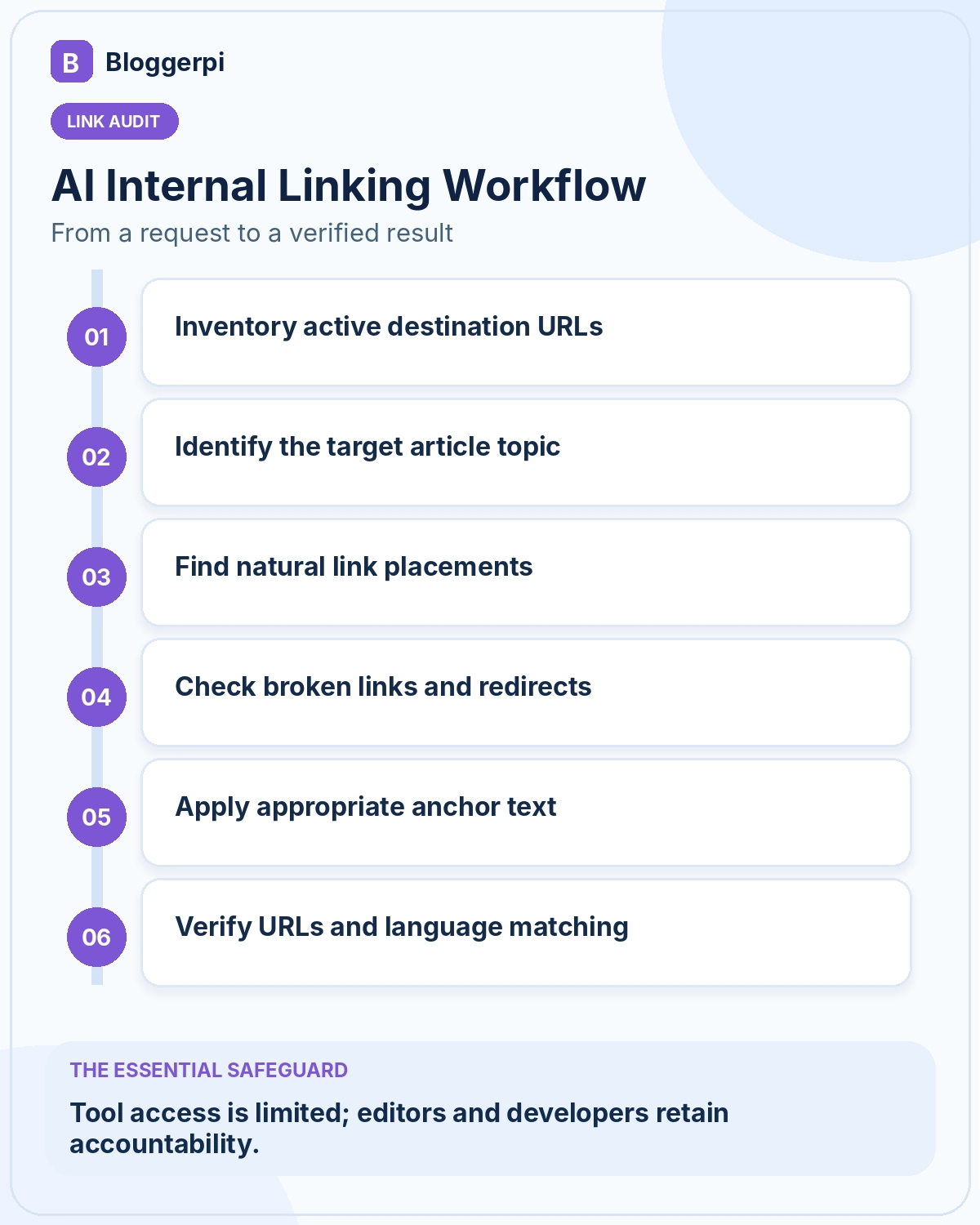
Step 1: Inventory Live Internal-Link Destinations
Begin with published pages that are suitable as destinations. A sitemap can help identify candidate URLs but does not prove that every listed address resolves successfully to its final canonical page. Where link-checking capabilities exist, verify the status and redirects for important destinations.
Organize destinations by subject, language, content type, and audience. An agency service page may be relevant to a commercial discussion, while an educational article may be a better destination when the reader is trying to understand a concept. Destination selection should follow intent, not arbitrary business priorities.
Step 2: Read the Source Article Before Editing
First identify the links already present. An article may have good internal references that should be preserved. It may also have repetitive anchors, outdated links, or generic phrases such as “click here.” Keep an inventory of the original links so the updated content can be compared with the source.
Consider the content structure. A link inside a paragraph is different from one embedded in a shortcode, data table, or page-builder element. Rewriting a complete post simply to change a small anchor can risk unrelated media and formatting. Limit edits to the target passage whenever technically possible.
Step 3: Select Natural Anchor Text
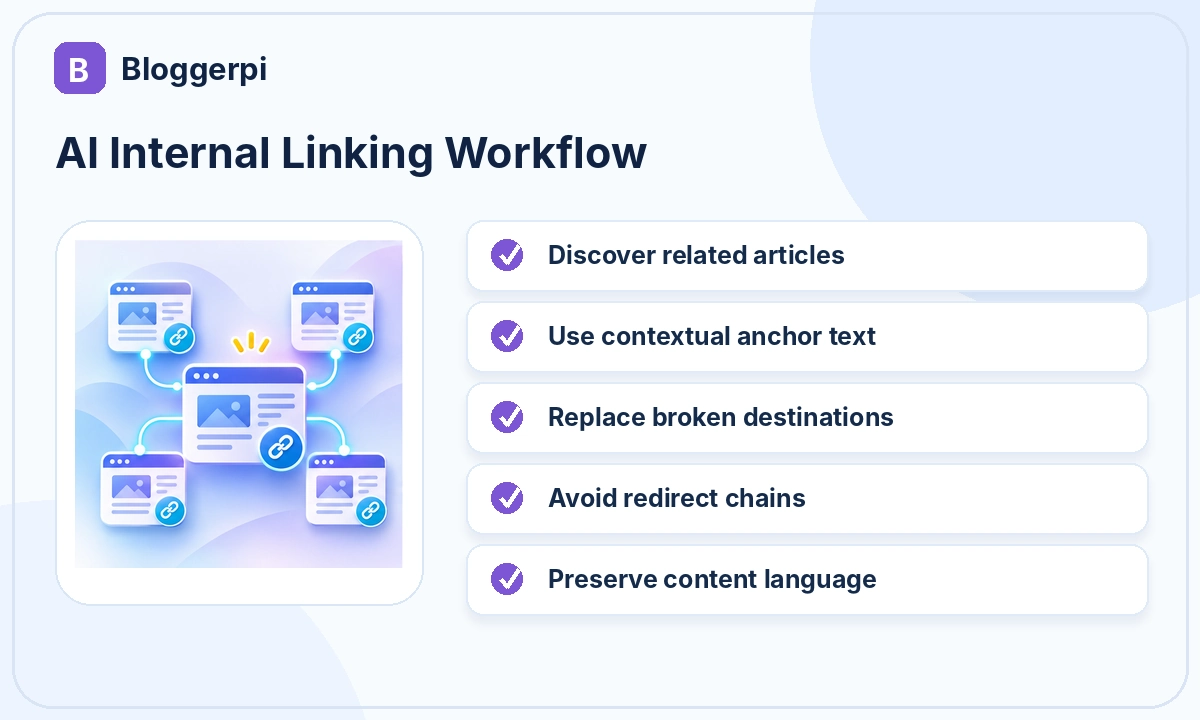
An anchor should tell the reader what they will find on the destination page and fit the surrounding sentence. If a paragraph naturally discusses key WordPress SEO elements, that phrase may be a better anchor than inserting a separate promotional sentence. The wording should remain useful even when the hyperlink styling is removed.
Avoid repeating the same exact-match phrase throughout the site, especially if it makes the writing awkward. ChatGPT can propose alternatives, but the editor should decide which wording best reflects the paragraph and the destination’s actual content. Our article about hyperlinks provides related background.
Step 4: Check Broken Links and 301 Redirects
A broken link and a 301 redirect require different handling. A broken destination may need a relevant replacement or removal; a redirect may already take the visitor to a useful page. Once the final destination is confirmed, linking directly to it can avoid unnecessary hops, but do not replace a redirected URL without checking what it now leads to.
When an old article no longer exists, choose an alternative that genuinely answers the same question. If no suitable destination exists, removing the link may be preferable to sending readers to a misleading page. A redirect should not be treated as a signal to substitute any vaguely related URL.
Step 5: Apply Approved Links Through WordPress Tools
Once the review list is approved, an authorized tool may edit the relevant HTML or WordPress block. Record the source URL, target destination, anchor, and paragraph context. These details make it easier to audit the result later, especially when the same rule is used across a batch of posts.
Preserve existing editorial and affiliate link attributes where applicable. Internal navigation should not automatically inherit rules intended for external sponsored links. If a page-builder structure cannot be safely edited through the available tools, a custom WordPress plugin or specialized function may be required.
Step 6: Verify the Saved Links and Language
The workflow is not complete when a write operation returns “success.” Retrieve the saved content and check the exact anchor and URL. Ensure that no nearby markup was damaged, no duplicate link was introduced, and the destination is still relevant. For consequential updates, inspect the frontend or preview.
Multilingual websites need an additional rule: English articles should normally link to English destinations, and Indonesian articles to corresponding Indonesian destinations. Translation pairing must be verified rather than inferred from similar titles. Do not insert links to unpublished drafts as though they are already live.
Example Prompt for Controlled Internal Linking
“Retrieve this WordPress article and list its existing internal links. Identify broken or redirected destinations and suitable contextual link opportunities. Suggest natural anchors in existing sentences, using only verified live URLs in the article’s language. Show the proposed changes before applying them. After approval, update only the relevant passages and verify the saved links, preserving all images, embeds, shortcodes, and editorial references.”
This workflow is related to the broader approach described in our Bloggerpi WordPress MCP case study. The purpose is not to create more hyperlinks automatically, but to make the site easier to navigate and maintain.
Risks of Unreviewed Internal-Link Automation
Common failure modes include irrelevant destinations, repetitive anchors, redirects to unexpected pages, language mismatches, and malformed content after a broad rewrite. A tool that can retrieve the article may not safely edit every nested element. When the required capability is absent, the appropriate response is to limit the scope or develop a specialized integration rather than forcing the change.
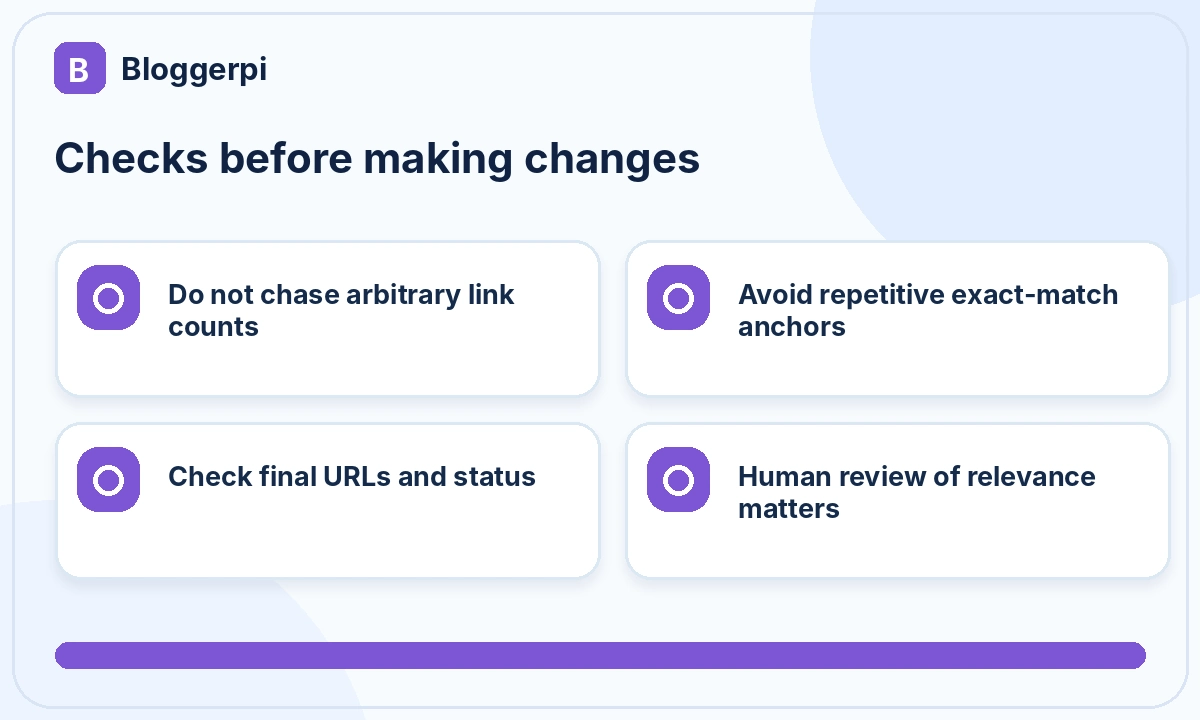
Human review remains essential because topical similarity alone does not prove a link helps the reader. An SEO specialist or editor should consider user intent, the destination’s quality, and the site’s content strategy. Tools provide execution and evidence; people determine the editorial value of linking decisions.
A Natural Anchor Example Compared with Forced Linking
Consider a paragraph that says, “Before updating an older article, check whether it still answers the reader’s original question.” If the site has a relevant guide to writing useful content, an existing phrase about answering the reader’s question may provide an appropriate link opportunity. The destination must genuinely help with the point being discussed.
Contrast that with inserting an unrelated promotional sentence such as “Click here for our best SEO service” into every article. The latter disrupts the reading experience and can undermine trust. An AI asked to hit a fixed number of links without context may produce similarly forced placements, which is why editorial rules should prioritize relevance over volume.
A Decision Matrix for Existing Internal Links
The Destination Is Live and Relevant
Preserve it when the anchor fits naturally. Updating links merely to change wording can introduce unnecessary risk without adding value for readers.
The URL Works but the Destination Topic Has Changed
Look for another page that directly addresses the intended subject. If none exists, consider removing the hyperlink. An HTTP 200 response alone does not establish editorial relevance.
The Link Redirects
Follow the redirect chain with an appropriate tool. If the final page still provides the promised information, a direct link may be preferable. If it resolves to an unrelated or generic page, the editor needs to reconsider the destination.
The Page No Longer Exists
Search for a suitable replacement based on topic and reader intent. If no credible replacement exists, remove the link while preserving the useful sentence. Do not invent destinations by guessing new slugs.
Scaling Internal Linking Carefully
Begin with a small batch that represents different article structures. One post may contain simple paragraphs, while another uses tables, video embeds, or shortcodes. Record the source URL, original destination, proposed replacement, reason for the change, verification status, and final result. This audit trail makes a batch easier to review than a broad “links optimized” completion message.
For multilingual sites, process languages separately. A URL prefix is not proof that a translated article exists. Verify the language relationship and publication status before choosing the new destination. Mark unsupported page-builder structures for manual inspection rather than risking a destructive rewrite.
When Not to Automate Link Changes
Manual work may be preferable when a destination cannot be verified, a source page uses complex markup, or a link is part of a critical conversion element. If only one sensitive link needs correction, the cost of configuring an automated workflow may exceed its benefit. MCP is a way to support appropriate processes, not an obligation to automate every edit.
Frequently Asked Questions
Should every article have the same number of internal links?
No. The number should follow article length and relevance, not a fixed target.
Must all 301 redirects be replaced?
Not necessarily. A direct link may be preferable when the final destination is confirmed and relevant, but checking is required first.
Can ChatGPT automatically fix broken links?
Only when an integration can inspect destinations and update the appropriate content fields. Replacement choices still need editorial validation.
How should multilingual internal links work?
Prefer same-language destinations and verify translation relationships before assuming two pages are equivalents.
Will more internal links guarantee better rankings?
No. Internal linking is part of site structure, not a standalone ranking guarantee.
Documenting Internal-Link Changes for Auditability
A useful link-change record should capture the source URL, paragraph context, old anchor and destination, proposed replacement, reason for the change, and verification status. These details make it possible for editors to distinguish a reviewed improvement from an automated guess.
Suppose an internal link now redirects because an article’s slug changed. Record the verified final destination, confirm that it still covers the intended topic, and only then decide whether to replace the old URL. This is more reliable than applying a global pattern replacement to every link containing the previous slug.
For multilingual articles, include the source and target languages in the record. Do not transform URLs by adding a language prefix without verifying that the translated page exists and is published. Where no appropriate destination is available, the editor can choose another page or remove the hyperlink while keeping the sentence meaningful.
Finally, make the process idempotent where possible: before adding a new anchor, check whether a relevant link is already present. This avoids duplicate insertions when the same article appears in more than one maintenance batch.
Choosing Which Pages to Link First
Not all posts need equal attention. Start with important guides and pages that help readers navigate major subject areas. Evaluate whether links to and from those pages support the intended reading journey. Priority can follow editorial relevance and site architecture rather than the age of a post alone.
Where several pages cover closely related topics, check whether each has a distinct purpose. Internal linking may improve navigation, but it cannot solve duplicate or overlapping content by itself. Our explanations of indexing and website crawling provide context for how pages are discovered.
Conclusion
ChatGPT and MCP can assist a structured internal-link workflow by connecting content analysis, URL validation, approved changes, and verification. The best results come from natural anchors and relevant destinations, not aggressive link counts. For related editorial work, see Bloggerpi’s content writing service.
