

Optimizing WordPress SEO with ChatGPT and MCP should not mean instructing an AI to rewrite every post and expecting Google rankings to rise. A better approach combines an editorial audit, specific objectives, access-controlled WordPress tools, and verification. ChatGPT can help interpret content and identify improvements; MCP can provide a structured way to reach the tools that retrieve or update supported website data.
At Bloggerpi.com, we have used such workflows for article reviews, Yoast SEO metadata, internal linking, and related content operations. Our experience shows that a tool’s “success” response does not necessarily prove the published page is correct. Saved values, existing embeds, and the frontend experience should be checked before claiming completion.
What Does MCP-Assisted WordPress SEO Actually Mean?
ChatGPT can assist with search intent, content organization, heading hierarchy, and metadata wording. Through a compatible MCP connection, it may retrieve the source article and call authorized operations to modify the relevant fields. The aim is to connect SEO planning with controlled execution while retaining a record of decisions.
MCP is not a search-ranking system. It does not automatically grant access to Google Search Console, crawling data, analytics, or every SEO plugin field. Each capability depends on the integration. For the underlying practices, review our on-page SEO guide and overview of essential on-page SEO elements.

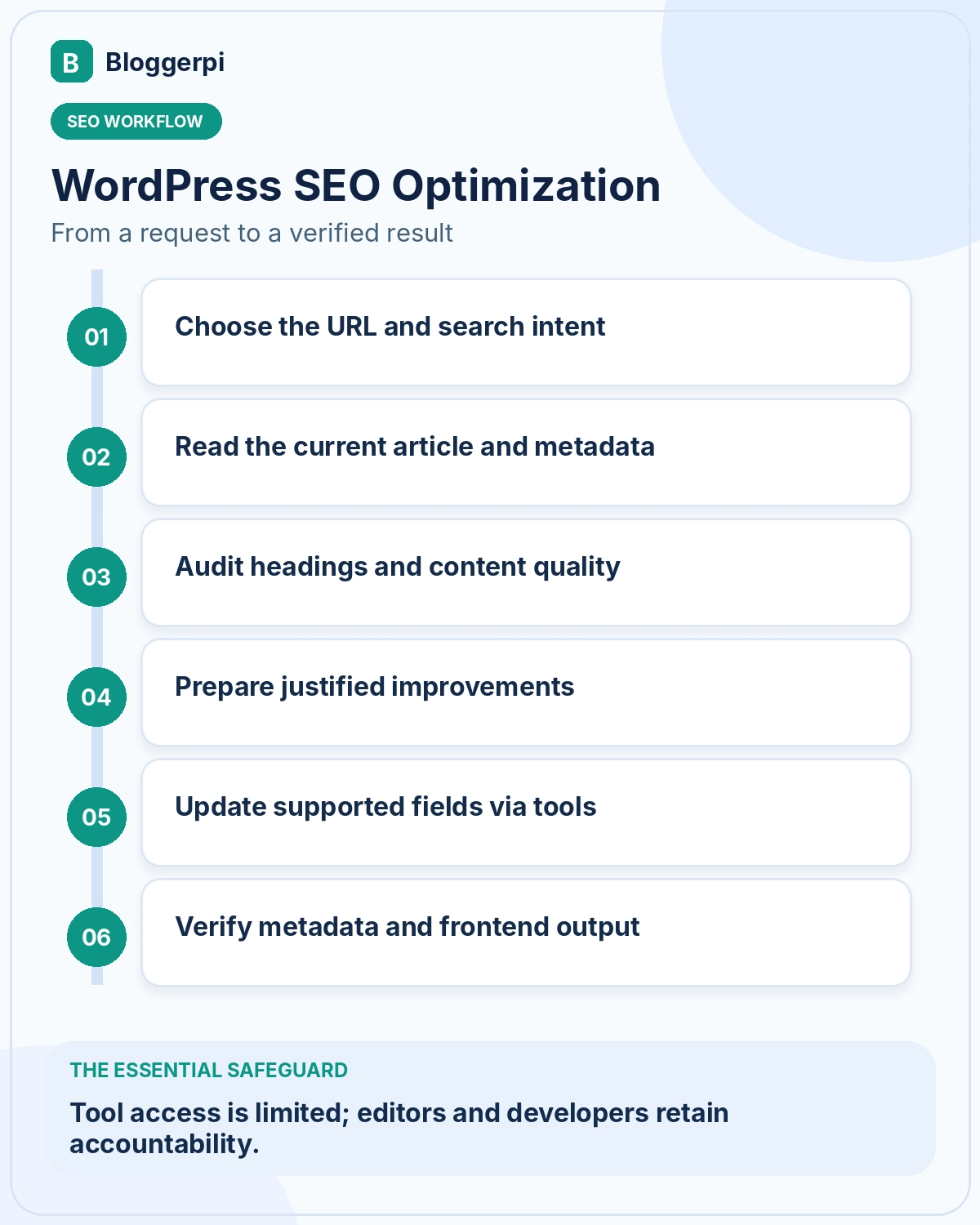
A Repeatable Workflow Begins with Search Intent and a URL
Choose a page that needs a defined change: perhaps an outdated guide, a page with an unhelpful description, or a post whose structure hides its main answer. Identify the actual goal, such as improving clarity, aligning the headline with the question, or removing irrelevant internal links. Those are concrete quality objectives; “make it rank first” is not an actionable instruction.
Before changing content, retrieve the original post and identify protected details. The permalink, publication date, author, video embeds, images, captions, shortcodes, tables, and conversion elements may all have editorial or functional value. Saving only a simplified rewrite can accidentally remove them.
1. Audit the Content and Heading Structure
Start by asking whether the article answers the reader’s primary question. A tutorial should provide a usable sequence. A comparison should explain meaningful differences and selection criteria. Keyword repetition is not a substitute for relevant information, accurate examples, or a clear conclusion.
Check the hierarchy of H1, H2, and H3 headings. A main section should be represented by H2, with relevant subtopics under H3. Avoid heading duplication and abrupt jumps that make the article hard to navigate. After applying any change through WordPress tools, inspect the saved markup and the rendered page; some themes and page builders transform heading presentation.
2. Improve SEO Titles and Meta Descriptions
An SEO title should accurately represent the page and be compelling without exaggerated claims. A meta description should help readers decide whether the result is relevant. ChatGPT can offer alternatives after reading the original article, but an editor should select the version that best matches the search intent and brand voice.
At Bloggerpi, Yoast SEO metadata is part of our workflow. An important technical distinction is that an API returning Yoast’s rendered metadata is not automatically a write API for all Yoast fields. The integration must expose an authorized update capability. After a change, retrieve the stored title and description again rather than relying only on a response message.
Handle slugs carefully. A published URL may have accumulated internal links or external references. Changing it without an appropriate redirect and canonical strategy can create avoidable problems. See our guide to meta descriptions and URL structure.
3. Review Internal Links and Content Relationships
Internal linking is most useful when it helps a reader explore a relevant next step. ChatGPT can inspect the surrounding paragraph, compare candidate destinations, and suggest natural anchors. A link-count target should not override topical relevance or readability.
Where tools permit, check whether candidate URLs are live, redirected, or broken. Replace a redirecting link with the final destination only after confirming that target is correct. On multilingual websites, English content should normally link to appropriate English pages, while localized versions maintain their own link networks.
4. Evaluate Images, Media, and User Experience
Images should clarify the topic, use descriptive alt text, and be optimized appropriately for their context. Oversized files or unreadable infographics undermine the reading experience. On a WordPress page, existing videos, figures, tables, and shortcodes must be preserved when the content is revised.
Frontend review matters as much as the stored HTML. A successful update can still produce poorly spaced headings or broken embeds on mobile. Editors should verify the final article rather than assuming the WordPress editor preview is identical to the public page. Our featured image guide explains related media considerations.
5. Prioritize Changes That Actually Help Readers
Not every proposed optimization needs to be applied. A historically important paragraph should not be deleted merely because an AI finds it repetitive. A keyword suggestion that makes the sentence awkward may hurt readability. The editor decides whether a change serves the article’s intent and the website’s broader editorial standards.
Keep separate records for recommendations, approved changes, performed operations, and verified results. These stages represent different levels of certainty. This distinction is especially useful in batch work, where one page may succeed while another contains content that requires manual review.
6. Apply Supported Updates and Verify Them
For each post, identify the exact ID or URL, retrieve its contents and metadata, prepare changes, preserve protected elements, and apply only the authorized operations. After saving, read the relevant fields again. Inspect frontend rendering when the change affects content structure, embedded material, or page layout.
Batch processes need explicit failure handling. Do not change author, date, canonical URL, language, or publication status unless the workflow requires it. Maintain backups or revisions before consequential edits, and report uncertainty when a result could not be independently confirmed.
Example Prompt for a Controlled SEO Audit
“Retrieve this WordPress article and evaluate its search intent, H2/H3 structure, readability, SEO title, meta description, and internal links. Preserve the URL, author, dates, images, videos, shortcodes, and essential editorial links. Propose improvements for review. Apply only approved updates using the available tools, then retrieve the saved values and report anything not verified.”
Such a prompt establishes a useful process rather than guaranteeing an SEO outcome. Our Bloggerpi MCP case study explores the wider WordPress management approach.
Limits: MCP Cannot Replace an SEO Strategy
An integration may retrieve posts but not have access to particular custom fields, structured page-builder data, or a third-party plugin’s internal settings. Sometimes a developer must build a custom WordPress plugin or add safe code to expose the required capability. This cannot be solved solely through a longer prompt.
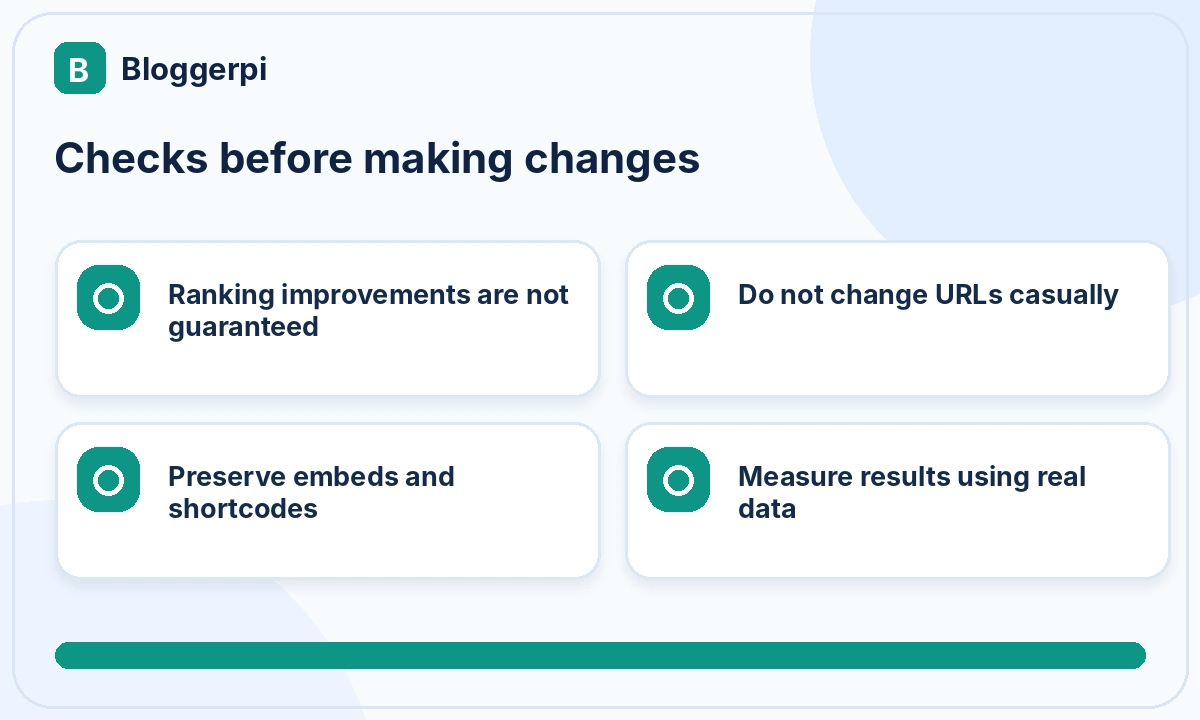
Human responsibility remains essential. Editors select which topics deserve investment, SEO specialists prioritize based on evidence, and developers evaluate the technical risks of a proposed change. We do not promise a particular traffic or ranking improvement from MCP; any measurable outcome needs valid before-and-after data and consideration of other influencing factors.
An Illustrative Before-and-After WordPress SEO Audit
Consider an old WordPress article titled “Website Tips.” Its title is vague, the introduction does not answer a focused question, and the meta description repeats generic terms without explaining what the page offers. Before editing, the team needs to establish whether the article is about site performance, security, content strategy, or another subject. Automatically changing the headline without that diagnosis can misrepresent the page.
After identifying the intended reader and search task, ChatGPT could propose a more specific title, reorder the headings, and improve the summary of actionable advice. For an article about performance, that may mean clarifying what PageSpeed Insights measures and avoiding unsupported guarantees about scores. An editor selects the justified changes, tests them in a draft, and verifies that images and important links remain intact.
This is an illustrative audit scenario, not a claim that a particular Bloggerpi article gained traffic. Its purpose is to show why a reliable SEO workflow starts with diagnosis rather than treating every old article as a candidate for wholesale rewriting. See our WordPress PageSpeed guide for related technical context.
What Should You Measure After an SEO Update?
Record the date, exact fields changed, target URL, the queries that matter, and relevant comparison metrics. Search Console trends such as impressions, clicks, and average position can inform analysis, but they can also change because of seasonality, algorithms, demand, and competitors. A post-update increase does not establish that MCP itself caused better organic traffic.
Measure operational quality separately: whether intended edits were saved, how many required correction, whether embedded content survived, and whether frontend links and pages still function. These indicators evaluate the reliability of the AI-assisted workflow even when SEO outcomes take longer to understand.
Choosing Between Content, Metadata, and Technical Fixes
A website problem is not automatically a copywriting problem. If a page is blocked from indexing or its canonical configuration is wrong, rewriting its introduction may not address the immediate issue. If the page is accessible but fails to answer its main question, content improvement could be the more appropriate next step.
Prioritize based on evidence. Confirm that the URL is reachable and eligible for indexing, evaluate content usefulness and search intent, review titles and descriptions, inspect internal links, and then consider media and user experience. The exact order can vary, but each proposed action should have a stated reason and an appropriate method of verification.
When Should AI Only Suggest Changes?
For sensitive claims, regulatory information, or facts that cannot be verified, it is often safer to request an audit report rather than immediate edits. The same applies to complex Gutenberg blocks, dynamic tables, and pages whose underlying editor structure is not supported by the connected tool.
Draft and Pending Review workflows provide a human checkpoint before content becomes public. MCP can assist with this process, but the ability to call a WordPress tool should not override editorial approval or technical QA. A fast change that is difficult to inspect or restore is not necessarily a successful optimization.
WordPress SEO with ChatGPT: FAQs
Can ChatGPT update Yoast SEO titles?
Yes, when the integration exposes the relevant authorized write tool. Read back the stored value afterward.
Does MCP improve Google rankings by itself?
No. MCP supports a workflow; it is not a Google ranking signal. Search intent, quality, site health, and competition still matter.
Should every article be rewritten?
No. Many posts benefit more from targeted factual updates, clearer structure, or metadata adjustments.
What happens to existing links during a rewrite?
They should be inventoried and preserved unless a reviewed replacement is justified. Relevant anchors matter more than arbitrary volume.
Is batch SEO automation risk-free?
No. It needs SOPs, backups, per-item logging, permission boundaries, and a reliable verification process.
Keeping SEO Standards Consistent Across Many Articles
On a content-heavy site, an editorial SOP can standardize quality checks without forcing every page into an identical template. Tutorials require clear instructions; comparisons need meaningful criteria; informational articles should answer the central question without unnecessary repetition. Consistency should apply to the review process, not arbitrary heading or word-count targets.
For batch SEO operations, group articles by language, category, and complexity. One set may require only metadata adjustments, another factual updates and restructuring, and a third contain fragile HTML or page-builder content that warrants manual work. This reduces the chance that an overly general instruction damages a wide range of pages.
Maintain separate statuses for proposed, executed, and verified changes. The distinction helps the team audit outcomes and prevents an unconfirmed tool action from being counted as finished work. Good reporting is as important as producing the initial recommendation.
Conclusion
ChatGPT and MCP can support practical WordPress SEO work by connecting content analysis to controlled update tools. Their value lies in repeatable, accountable workflows, not claims of automatic ranking success. Editorial expertise, technical compatibility, and human QA remain necessary. Learn more about our SEO content writing services and case studies.
