

Cross-border ecommerce marketing is more complicated than choosing an international marketplace and switching on an advertising campaign. Sellers must identify an attainable target market, verify that their products can be sold and shipped there, explain the full buying experience, and evaluate whether customer acquisition costs leave a sustainable margin. Search engine optimization, Google Ads, Meta Ads, marketplaces, and multilingual websites can all play a role, but none guarantees orders or profitability.
This guide is for small businesses, online merchants, and digital marketing teams planning to reach buyers beyond their home country. It takes the perspective of a seller who needs both an acquisition strategy and workable operations. Examples are illustrative rather than real sales results or country-specific legal advice. Rather than trying to launch everywhere, the better starting question is: which one or two markets can we serve reliably and measure accurately?
What should a business check before selling internationally?
Start with four questions: who is the buyer, which customer problem does the product solve, can orders be fulfilled legally and reliably, and what does each order cost after fees, delivery, and service? Demand at home does not prove demand elsewhere. Country-specific search results, relevant marketplaces, customer questions, and conversations with prospective buyers can provide signals. Our market segmentation guide offers a useful way to distinguish audiences based on needs rather than treating the entire world as one campaign.
Prepare product descriptions, authentic images, specifications, sizes, materials, origin information, and a realistic return policy. Regulated categories can face additional requirements depending on the destination, including food, cosmetics, children’s products, batteries, and products making health claims. The seller’s registration, tax position, customs declarations, and payment eligibility also matter. An advertisement cannot replace product compliance or a reliable shipping arrangement, so confirm the actual obligations with authoritative sources and logistics specialists.
1. Select target countries based on evidence rather than excitement
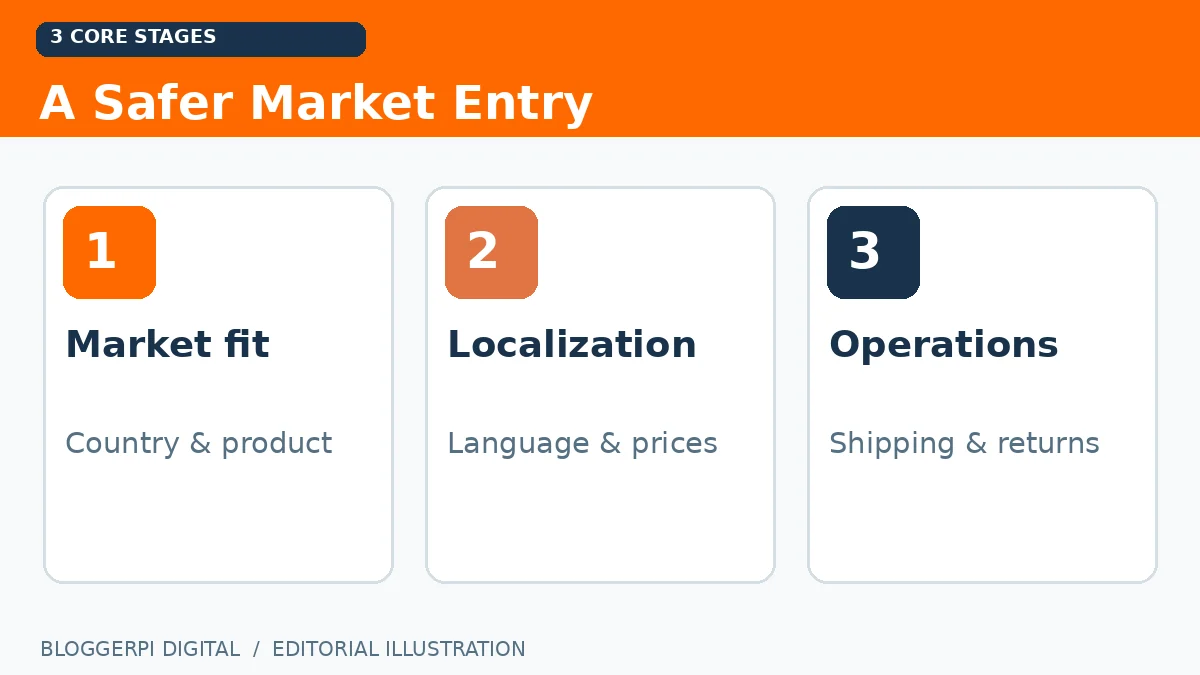
A shared language does not make two markets interchangeable. Buyers may differ in local terminology, preferred payment methods, sizing conventions, seasonal demand, or expectations about delivery and returns. Identify a shortlist of countries where the product is permitted, carrier coverage is available, and the business can provide customer support. Compare competitor offerings and what prospective buyers appear to search for. Record assumptions separately from observed demand.
Consider a small home décor brand testing overseas interest. A broad term such as “wooden decoration” may describe many unrelated intentions. A phrase that identifies the material, use case, style, or size can be more actionable. Use our explanation of buying-intent keywords to distinguish information seekers from potential purchasers. Even an apparently attractive keyword does not mean the country is viable if fulfilment costs are excessive or the product lacks required documentation.
2. Model contribution margin before buying traffic
Calculate the economics of a representative order. Start with the selling price, subtract the cost of goods, packaging, marketplace and payment fees, any shipping subsidy, taxes or duties that the seller is responsible for, an allowance for returns, and estimated advertising costs. The result is a contribution toward other operating expenses, not automatically net profit. Storage, staff time, software, and other fixed costs still need separate consideration.
Paid campaigns should have an acquisition cost limit grounded in those economics. A campaign can bring in many inexpensive clicks but still lose money on each shipment. Similarly, a high reported return on ad spend can coexist with expensive shipping or high refund rates. Our guide to revenue versus profit explains why sales totals cannot substitute for sustainable unit economics. Use best-case and adverse-case scenarios for planning, but never present hypothetical numbers as actual results from a customer campaign.
3. Choose between international marketplaces and your own store
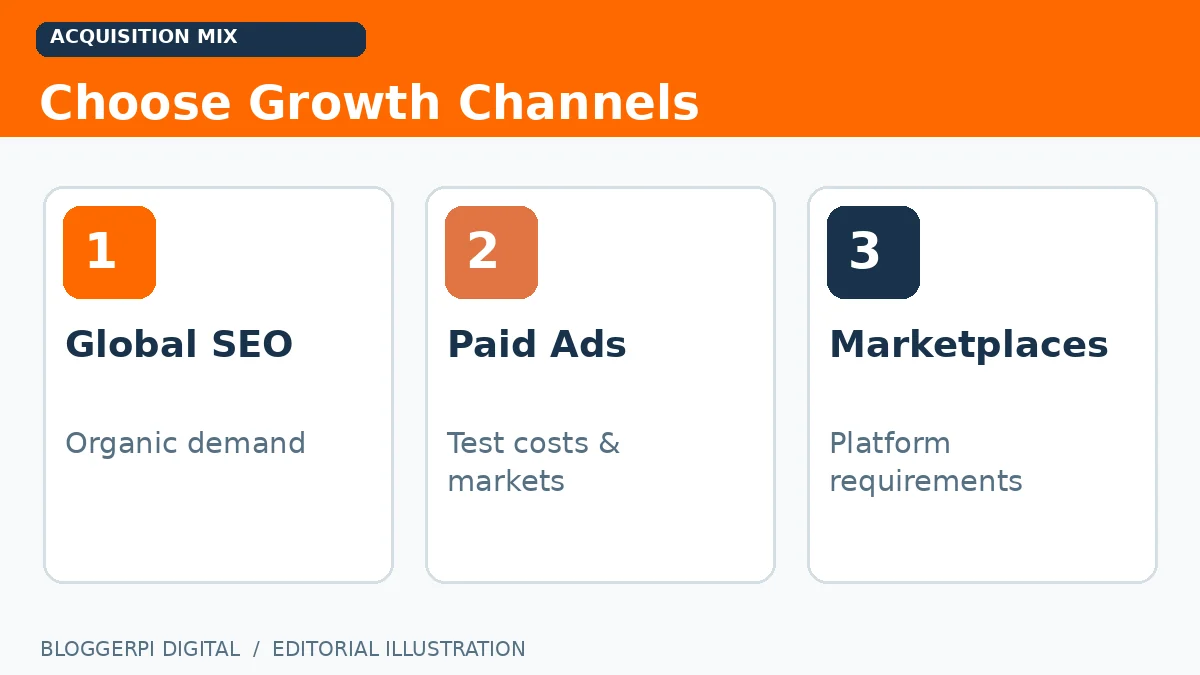
An established marketplace may offer a familiar discovery experience, payment workflows, and seller tools. In exchange, it can impose listing requirements, category restrictions, fees, local compliance rules, dispute procedures, and fulfilment conditions. Whether sellers in a particular country can join Amazon, Etsy, eBay, or another platform depends on the current platform policies. Do not assume every site supports every origin country or provides universal free international shipping.
An independent ecommerce site gives a brand more control over editorial content, organic discovery, customer experience, and data collection within privacy rules. That freedom brings responsibilities for payments, security, taxes, shipping, customer service, and traffic acquisition. Our overview of business website types can help decide whether a catalog, landing page, or full checkout system suits the current stage. Many sellers use marketplaces to validate products and their own website to develop a longer-term customer relationship; the appropriate mix depends on resources and product fit.
4. Build a genuinely localized multilingual shopping experience
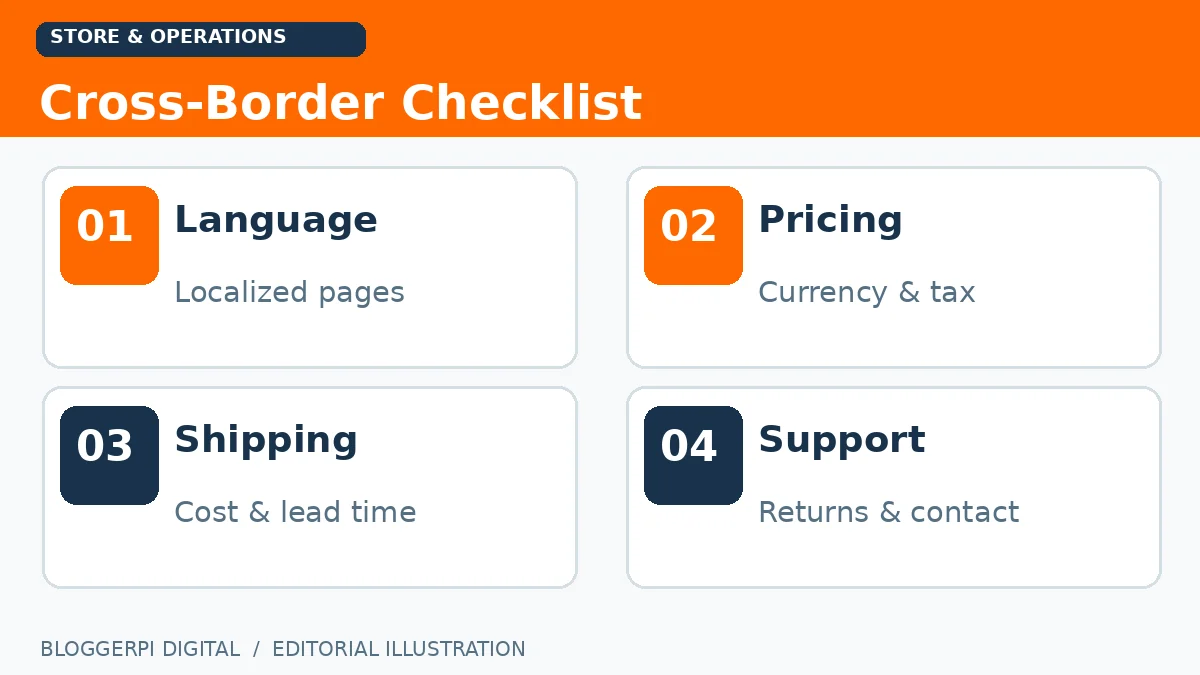
Translation should extend beyond the checkout button. Product descriptions must make sizes, materials, variants, delivery promises, warranty terms, support options, and return conditions understandable to the target audience. Show accurate currency information and explain when extra charges may be due. Even markets that share a language may use different product terminology or measurement systems. A word-for-word translation of a domestic product page may therefore fail to answer actual overseas buyer questions.
For multilingual WordPress stores, use stable, crawlable URLs for each language and connect their variants with accurate hreflang and canonical information. Google advises against automatically redirecting every visitor based solely on an assumed language or geographic location. Our guide to managing multilingual WordPress explains translation relationships, while these on-page SEO examples help structure titles, headings, descriptions, and navigation. Localize the whole shopping journey, including transactional emails and customer support, before expecting a translated landing page to convert.
5. Use international SEO to answer country-specific buying questions
International SEO begins with the actual language of customer problems. Research category terms, synonyms, sizing vocabulary, delivery questions, and return expectations for each market. If two countries use the same phrase for different needs, a localized page should address the difference rather than simply duplicating a generic template. Avoid producing hundreds of low-value pages for country names just to target searches. Product availability and fulfilment should agree with what the page promises.
Search Console and market-specific search results can inform your plan. Our long-tail keyword research walkthrough offers a way to collect relevant phrases, but autocomplete suggestions are not verified sales volumes. Technical SEO also matters: keep navigation consistent, avoid conflicting canonical tags, and maintain appropriate sitemaps. Our WordPress SEO optimization guide covers the foundation before a store expands to several language and country variants. A polished page cannot compensate for a product that cannot be delivered to the buyer.
6. When Google Merchant Center and Shopping make sense
Merchant Center helps eligible merchants manage product data and participate in supported Google surfaces. International targeting requires attention to product feed details, supported currencies and languages, shipping, seller eligibility, and the rules of each destination. Adding a country to a data source does not automatically make every offer eligible for all placements or start a Shopping ad campaign. Advertising settings and actual fulfilment coverage must be aligned with the countries the merchant intends to serve.
Keep feed details consistent with the website and checkout: product titles, price, availability, currency, shipping cost, delivery time, and return policy. Where multiple target countries are supported, use the data source and shipping features according to Merchant Center’s current documentation. Do not advertise a low price that is later undermined by undisclosed conditions. If the business does not use Merchant Center, international organic SEO and alternative marketplace discovery still need the same basic product accuracy and customer transparency.
7. Test Google Ads by market and search intent
Google Ads can reach people expressing a clear product need, but geographic targeting is not always a simple statement that every click came from someone physically located in the selected country. Campaign settings can distinguish a person’s presence from signals of interest in a location, with available options depending on the campaign type. Read the specific geographic targeting choices before testing. Select a country because the business can serve its buyers, not merely because search traffic looks attractive.
Begin with a narrow group of products that have known margins and working delivery options. Organize ads around purchase intent, send people to a localized and mobile-friendly landing page, and monitor qualified actions. Define a test budget and a stopping rule. Review search terms and exclusions where available, then compare cost against actual transactions rather than impressions alone. Our guide to website traffic sources helps keep paid search, organic search, referral, and direct visits distinct in reporting.
8. Use Meta Ads and creator partnerships with evidence
Meta advertising may help test product messages through images, short-form video, and audience selection options such as location. Available targeting controls depend on the objective, platform rules, and account context, and may change over time. A visually distinctive item might benefit from a demonstration, while an unfamiliar product may need more explanation of materials, intended use, and origin. Do not fabricate customer endorsements or performance statistics to make an advertisement appear compelling.
Test a small number of genuinely different messages. For example, one creative could explain a practical problem, another could show product craftsmanship, and a third could address common sizing questions. Compare meaningful website behavior and purchases rather than optimizing only for likes. If partnering with creators, follow our influencer marketing strategy guide and comply with disclosure obligations. A social media management workflow can keep execution organized, but scheduling posts does not replace audience research.
9. Coordinate customs, international shipping, and returns
A digital campaign becomes a reputational problem when a seller cannot honour the advertised delivery time. Before accepting orders, check carrier coverage, restricted goods, customs documentation, insurance when appropriate, who is responsible for taxes and duties, and the likely delivery window. For goods exported from Indonesia, the Directorate General of Customs and Excise provides guidance on postal and other export consignments; applicable procedures depend on shipment type, product, and service provider.
Do not copy a customs rate or tax figure from an old blog post and treat it as universal. The destination country, classification, declared value, contract terms, and current regulations can change the obligations. Explain returns honestly: where goods are sent, who pays return shipping, what condition is required, the refund process, and how customers can request assistance. If a particular destination cannot be supported with an acceptable return process, say so before the purchase rather than resolving the surprise afterwards.
10. Design product pages to reduce avoidable hesitation
A helpful landing page includes authentic product images, variants, materials, dimensions, intended uses, shipping information, a real return policy, accessible support, and credible reviews. Avoid promising free global shipping when it applies only under narrow conditions. Test selection controls and checkout on mobile devices, including what happens when payment fails or a shipping address is unsupported. Speed matters, but so do clarity, trust, and an accurate total cost. The principles of conversion rate optimization offer a structured approach to prioritizing improvements.
Use customer reviews only when they are genuine and correctly attributed. A buyer in another country may particularly need evidence that the product matches its description and the company responds to problems. Our guide to customer testimonials discusses credible social proof, while product identity principles can help keep an international store visually consistent across its website, packaging, and marketplace listings. Do not publish structured review ratings that are not supported by actual displayed content.
11. Track purchases, returns, and business margin separately
Google Analytics 4 can record ecommerce activity when the implementation sends appropriate events such as view_item, add_to_cart, purchase, and refund. Check that transaction identifiers, item data, and currencies are accurate and that one completed order does not trigger duplicate purchase events. Marketplace sales may not appear in a website’s own GA4 property, so combine reports only when definitions and access genuinely allow it. Avoid treating incomplete analytics as complete business revenue.
For WordPress, our Site Kit, GA4, and Search Console setup guide explains foundational reporting, but installing Site Kit does not automatically guarantee complete ecommerce event tracking. Compare cost per acquisition, return on ad spend, average order value, refunds, and contribution margin. Our customer retention strategy guide is useful when a repeat purchase could make an otherwise expensive initial acquisition more sustainable. Decision-makers need to know the difference between traffic growth, gross sales, and cash retained after fulfilment.
12. A controlled 30-day international market test
Week 1 — market and product validation: choose one destination and a small shortlist of feasible products, research local terminology, and confirm product and carrier requirements. Do not spend on advertising before the business knows whether orders can be fulfilled. Week 2 — customer journey: prepare localized product pages, accurate shipping estimates, permitted payment options, return information, and basic measurement. Test the complete purchase experience as a customer.
Week 3 — measured acquisition: launch one limited channel with a defined cost ceiling, then compare search queries, creative messages, traffic quality, and operational feedback. Change one major variable at a time to make outcomes easier to interpret. Week 4 — evaluation: document valid orders, acquisition costs, refunds, customer service issues, and shipping performance. Expand only when market demand and operational reliability have supporting evidence. This is an illustrative experiment design, not a guaranteed revenue schedule or universal budget recommendation.
Common mistakes when selling overseas
Typical errors include targeting every country at once, pricing without delivery and return costs, publishing poor machine translations, launching ads before shipping is ready, and equating impressions with paying customers. Some sellers also assume that a marketplace will supply orders automatically or handle every compliance requirement on their behalf. Others report a campaign as profitable while ignoring refunds, payment fees, or labour costs. A working reporting process must make those assumptions visible.
Avoid recommending closed marketplaces, outdated fees, or shipping subsidies that no longer apply. Seller onboarding policies change and often differ by country or product category. Check official platform requirements before adding a marketplace to a recommendation. A product that performs well in one region is not automatically suitable for another, even when the language and advertising platform appear familiar.
Frequently asked questions about cross-border selling
Can a small Indonesian business sell products internationally?
Often yes, depending on the category, destination regulations, export paperwork, permitted payments, and carrier availability. Review actual requirements for the product and shipment.
Do I need a multilingual website immediately?
Not in every case. A marketplace may be a useful test channel, but localized website pages can support brand understanding and a more controlled customer experience.
Does Google Ads guarantee overseas orders?
No. Advertising distributes a message; purchases depend on demand, offer quality, landing pages, delivery, total cost, and many other factors.
How should I compare international marketplaces?
Check eligible seller countries, product categories, payment options, fees, fulfilment, dispute rules, returns, and account terms directly on the platform.
Can every type of product be exported?
No. Categories and destination markets can impose legal restrictions, documentation, or certifications. Confirm before listing and accepting orders.
Is Google Merchant Center mandatory?
Not for every sales model. It is useful for eligible product data and Google placements, but does not replace store operations or compliance.
Should my product show the buyer’s local currency?
Accurate localization often helps, but it must match payment, taxes, feed data, and the customer’s actual checkout experience.
Who pays import duties and taxes?
That depends on law, country, shipping terms, and the commercial arrangement. Do not promise a duty-paid delivery arrangement without confirmation.
Does strong return on ad spend mean the store is profitable?
Not necessarily. ROAS excludes many costs that can materially affect profitability, including goods, fees, delivery, staffing, and returns.
Which metrics should I monitor first?
Track valid orders and contribution margin alongside acquisition cost, return rates, fulfilment problems, and conversion behavior.
Does the same strategy work for digital products?
Research, localization, SEO, ads, and analytics remain relevant, but digital licensing, tax, fulfilment, and access rules differ from shipping physical products.
Official sources
- Google Merchant Center — Multiple target countries
- Google Merchant Center — Cross-border Shopping setup
- Google Merchant Center — Supported languages and currencies
- Google Search Central — Localized page versions
- Google Ads — Geographic targeting guidance
- Meta for Business — Ad targeting
- Indonesia Customs — Export consignments FAQ
- Google Analytics 4 — Ecommerce events
- Google Analytics — Setting up purchases
International growth works best when acquisition and operations are designed together. If your team needs localized landing pages, multilingual SEO, and reliable measurement, start with a website audit, SEO content writing support, and one tightly scoped market experiment before expanding your advertising budget.
