

Can businesses in Indonesia claim a profile on ChatGPT? Some may be able to do so, provided the organization meets OpenAI’s eligibility requirements and the relevant verification method is supported. OpenAI has introduced Businesses in ChatGPT for eligible businesses in locations where ChatGPT is available, but availability is not identical across industries, business categories or countries. A visible claim option is not an automatic promise that every business will be approved.
One distinction is especially important for Indonesian companies. OpenAI’s Help Center currently says local stores and restaurants can only claim existing listings in the United States. Eligible online businesses may have different options to claim an existing profile or add one, depending on supported verification. Separately, Business Agents launched for qualifying US ecommerce and online service businesses rather than all organizations that are able to claim.
This guide explains those limitations, how to check a particular company’s eligibility, which evidence you may need, and how to respond when a listing is missing or already claimed. It also discusses the Kelanakids example previously documented by Bloggerpi: a real domain-based claim from an Indonesian business, which demonstrates a particular successful process but not universal access. Reviewed November 16, 2026; the product is still in beta.
What OpenAI Officially Says About Geographic Eligibility
When OpenAI introduced Businesses in ChatGPT on November 10, 2026, it described a claim opportunity for eligible businesses located where ChatGPT is available. That announcement establishes a general principle, but the key word is eligible. A country having access to ChatGPT does not mean all of its industries, locations or profile types necessarily satisfy OpenAI’s checks.
The official Businesses in ChatGPT page adds that eligibility depends on industry, location, verification and integrity reviews. The product policy allows OpenAI to decline or delay categories that raise significant safety concerns or require additional safeguards. It can also reject false ownership, duplicate listings or inaccurate profile claims.
For businesses outside the US, this creates a practical distinction between an announced global eligibility principle and the actual options present in a particular Business Hub account. The correct answer is to inspect the real listing and available verification methods rather than assuming that every path shown in a US-based product demonstration will be identical in Indonesia.
Online Businesses Versus Local Stores and Restaurants
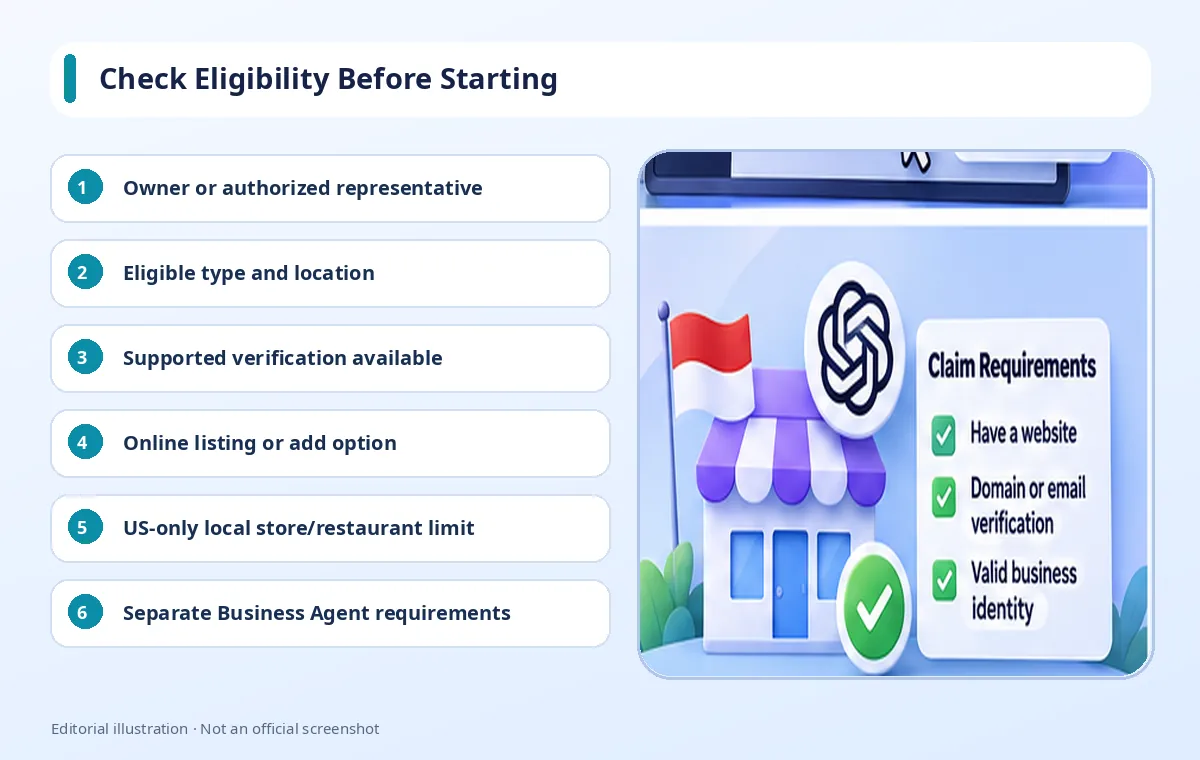
An Indonesian ecommerce or website-based business
An ecommerce store or online service provider with an official website can check whether Business Hub finds a matching profile. OpenAI’s Help Center says that, where supported, an eligible online business may see an option to add a business if the listing does not yet exist. The wording is deliberately conditional: there is no public guarantee that every online retailer or agency will qualify.
Having a website may be an important part of the original rollout, but a domain alone does not determine eligibility. The claimant must own or be authorized to represent the business, the company must meet policy requirements, and the account must be offered a supported verification route. If any of those conditions is absent, the company may need to seek help or wait for availability to expand.
Physical shops, restaurants and other local listings
Local stores and restaurants are subject to a narrower current rule. According to the Help Center, they can claim only an existing US listing. Therefore, an owner of a café, restaurant or small neighborhood shop in Yogyakarta should not assume it can create or claim a new Indonesian local listing using the same path. The limitation reflects the product rollout at the time of writing and may change later.
Do not attempt to bypass the restriction by selecting a false US address, misrepresenting the business type or duplicating another organization’s profile. OpenAI’s business policy requires accurate identity, location, affiliation and offering information. An organization with both ecommerce and a physical location should use the category and claim options OpenAI actually makes available rather than deciding unilaterally how it must be classified.
Online service providers and agencies
A digital agency, consulting company, software business or online learning service with an Indonesian website may want to check its eligibility because the service can operate independently of a walk-in shop. Yet the claim workflow is still subject to category, location and verification rules. No marketing agency can correctly promise automatic approval just because it can access a client’s DNS settings.
While availability is being assessed, the company can still improve its website. Accurate service descriptions, contact routes, case studies and relevant FAQs remain valuable for customers regardless of Business Hub status. Our guides to trustworthy content practices and ChatGPT Search and SEO offer complementary website-level considerations without making unsupported claims about a Business Hub ranking advantage.
What the Kelanakids Claim Example Does—and Does Not—Prove
The earlier Bloggerpi walkthrough records a Kelanakids claim using its official website domain. Five screenshots illustrate the verification-method screen, listing details, DNS TXT instructions, claim review and approval confirmation. This example is useful because it demonstrates a real process rather than a hypothetical sequence. The submitted domain belonged to a business operating in Indonesia.
However, the example is not a statement by OpenAI that every Indonesian business can claim. It records one eligible listing and its available method at a particular time. A subsequent dashboard view also showed a confirmed website-access status while the account still requested identity verification through Persona. Those observations support the distinction between claim approval and completed access to additional management features.
Readers can examine that documented workflow in our step-by-step business claim tutorial. They should never reuse a DNS TXT token copied from a screenshot, because the record belongs to a particular verification request. A new claimant must use the type, hostname and value displayed in its own authorized Business Hub session.
Requirements to Review Before Starting an Indonesian Claim
- Ownership or authority: the person submitting must own the business or hold permission to act for it.
- Eligible business type: the organization must be supported under the current industry and integrity rules.
- Supported location: geographic availability can differ, particularly for local stores and restaurants.
- Correct listing: the business must have an existing match or a legitimate Add business path where available.
- Usable verification: Business Hub must offer a method the claimant can complete lawfully, such as phone, email, DNS or Shopify.
- Claim approval: OpenAI reviews submitted evidence and may request additional information.
- Persona verification: advanced features require separate approval of the owner’s or representative’s identity.
Some owners may be asked to provide a government-issued identity document, company registration information or evidence of representation during Persona. Those documents should be uploaded through the official verification flow. Do not share them with a stranger who claims to guarantee faster review, and do not allow external consultants to claim a business without clear authorization.
How to Check Whether Your Indonesian Business Can Be Claimed
- Sign in to ChatGPT on the web using the intended business administrator account.
- Open Business Hub in the sidebar or through the official product page.
- Search for the actual company name and check the listing’s website, location and details.
- If no listing is found, see whether your online business is offered an eligible Add business option.
- Review the available claim-verification methods without inventing missing business information.
- Complete the selected method, then wait for OpenAI’s approval or additional-information request.
- After approval, proceed through Persona if you need to publish profile changes or access other eligible features.
This process is a practical eligibility test for one organization, not an official certification of an entire country or industry. An eligible company may still see different interface labels from published demonstrations. If the expected option is unavailable, check the documented restrictions and use official support rather than trying to create a substitute listing with inaccurate details.
Which Claim Verification Methods Might Appear?
Business email or phone
A business-email claim uses a code sent to an address associated with the organization, while a business-phone method can use SMS or an automated call. The methods appear only when supported for the listing. You should control the mailbox or phone legitimately and avoid forwarding one-time codes to a public channel or unauthorized service provider.
Website domain and DNS TXT records
When Website domain is offered, ChatGPT shows a TXT record to add under the domain’s authoritative DNS settings. The record includes the type, name or host and value. Copy all three exactly, allow for DNS propagation, and return to select Verify domain. Entering the value into the wrong DNS provider will not establish control. For domain owners, coordination with their IT team is preferable to experimenting with production records.
Shopify verification
Eligible Shopify merchants can connect their store using the permissions and login flow shown in Business Hub or Shopify administration. The merchant must have lawful control of the relevant store. Shopify is not required for all claimants or for every eligible Business Agent, and a store connection is not proof that an entirely separate brand or location has been claimed.
Claim Eligibility Is Not Business Agent Eligibility
Even after a claim is accepted, OpenAI requires Persona identity verification before publishing business changes, connecting product feeds, accessing available insights or creating an eligible agent. The Help Center specifies that the blue verification badge appears after Persona approval. In the beta, submitting a government ID or DNS record without receiving approval does not satisfy those requirements.
Business Agents are a different product tier in terms of eligibility, not simply the next button for every business. At launch, they are available to eligible ecommerce and online service businesses in the United States that also meet applicable industry requirements. A business based in Indonesia may be able to access its profile without being eligible to publish an agent. The two questions must be answered separately.
For businesses not eligible for an agent, there is still value in maintaining an accurate website, answering customer questions, and keeping product details consistent. Those activities can continue through the organization’s own channels without waiting for a specific ChatGPT feature to reach the country.
What If the Business Is Missing, Locked or Already Claimed?
If the search does not return a listing, check the name and official website first. Eligible online businesses might see an Add business option. If the option is not available, do not invent a false profile or alter the claimed country to sidestep the restriction. Review OpenAI’s current eligibility wording and wait for an appropriate supported path.
For an existing listing claimed by someone else, OpenAI provides a Dispute ownership option under the profile’s more-options menu. The process may require Persona to establish that the new claimant has legitimate authority. A locked listing may display Contact support, which should be used rather than attempting to take over another person’s account.
If a claim is pending, OpenAI says the review time varies and decisions or requests for more information are sent by email. Do not repeatedly resubmit the same claim while the current one is under review. For a technical error, keep a record of the exact step and error message, but redact identity numbers, private email details and verification tokens from screenshots shared for assistance.
Infographic: Checking Indonesian Business Eligibility
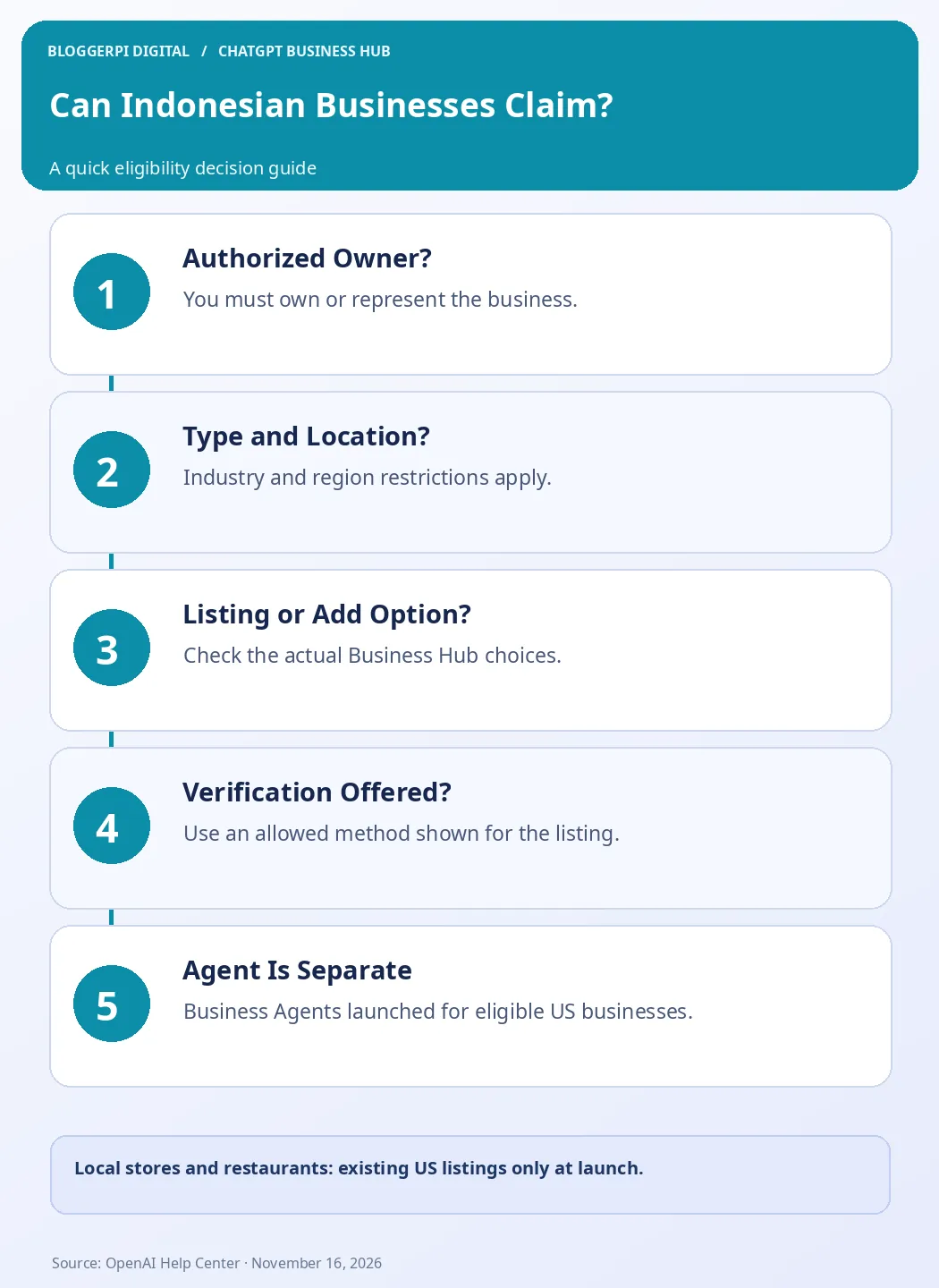
The infographic is a concise decision guide rather than an authoritative approval checker. It highlights the questions that matter most: who owns the business, what category it belongs to, whether the location is supported, whether a verification method is offered, and whether the desired feature is a business profile or an agent.
Frequently Asked Questions
Can every Indonesian business claim its profile?
No. Eligibility depends on business type, location, supported verification and integrity checks.
Can an Indonesian ecommerce company apply?
It can check for an eligible listing or available Add business flow, but the platform does not guarantee acceptance of every online merchant.
Can a restaurant in Jakarta create a new local listing?
Current Help Center guidance limits local stores and restaurants to claiming existing US listings, so the Indonesian local path should not be assumed available.
Does Kelanakids prove Indonesia-wide eligibility?
No. It documents one successful website-domain claim from one Indonesian business and account.
Is a website required?
The initial rollout emphasizes eligible businesses with a website. The available claim and verification options determine what a particular account can complete.
Is Persona still needed after claim approval?
Yes for publishing business-information changes, using available Insights and feeds, and creating an eligible Business Agent.
Are Business Agents available in Indonesia?
At the November 2026 launch, agent eligibility is limited to qualifying ecommerce and online services in the US.
Is a paid ChatGPT Business plan required?
No. Claiming an eligible business does not require an Ads account or a ChatGPT Enterprise agreement.
Conclusion: Check Actual Eligibility, Not Countrywide Claims
Some Indonesian businesses can potentially claim a profile if they satisfy the program’s current requirements and receive a supported verification path. That does not mean every local shop or restaurant is eligible, and it certainly does not establish Business Agent access across Indonesia. The Kelanakids example is evidence of one successful claim process, not an exemption from the broader eligibility rules.
Start with the real company listing and current Business Hub options, protect the identity-verification process, and continue strengthening accurate website information regardless of access. For the documented domain process, see Bloggerpi’s business claim walkthrough.
Official Sources
- OpenAI Help Center — Setting up your business on ChatGPT
- OpenAI — Introducing Businesses in ChatGPT
- OpenAI — Businesses in ChatGPT
- OpenAI — Businesses in ChatGPT Policy
