

ChatGPT Business Hub vs Google Business Profile: which platform should a business prioritize? Both help organizations manage information that potential customers may discover, but they serve different environments. ChatGPT Business Hub is designed for eligible business profiles and aggregated interaction within ChatGPT, with additional product-feed and Business Agent capabilities for qualifying organizations. Google Business Profile helps eligible local businesses appear in Google Search and Maps with information such as hours, locations, service areas, reviews, calls and directions.
The right choice depends on how customers engage with the company. A restaurant where people need opening hours and directions has different needs from an online retailer selling nationally, and a service-area plumber differs from a remote software consultancy. It would be misleading to say that one business listing always replaces the other, or that claiming both automatically guarantees higher rankings.
This comparison explains eligibility, verification, available information, customer actions and performance reports using OpenAI and Google documentation reviewed on November 16, 2026. It also shows how to build a sensible cross-platform plan without treating ChatGPT mentions as the same metric as Google profile views. Businesses in ChatGPT is a recent beta release, so some features may change.
What Is ChatGPT Business Hub?
Business Hub is OpenAI’s management area for businesses in ChatGPT. Owners and authorized representatives can claim an eligible business profile using a method offered for that listing, such as business email, phone, website DNS or Shopify. After claim approval, the organization can access its profile. Approved Persona identity verification is required before publishing business-information changes, connecting feeds and viewing available insights.
For qualifying organizations, Business Hub can include structured product feeds with current prices and availability. OpenAI has also launched Business Agents, clearly identified conversations that represent one business using its supplied product and policy information. Agent eligibility is distinct from listing eligibility: at launch it is limited to certain US ecommerce and online service businesses. A profile can therefore be claimed without an agent being available.
The reported metrics can include website references or mentions, website clicks and discovery topics. Those metrics are aggregated and may be blank when privacy thresholds have not been reached. Our Businesses in ChatGPT introduction and real dashboard review explain those concepts in more depth.
What Is Google Business Profile?
Google Business Profile is a free management tool for eligible businesses appearing in Google Search and Google Maps. Once a company adds or claims its listing and completes verification, it can maintain accurate business details. Depending on the profile and category, customers can see opening hours, the address or service area, a phone number, photos, public reviews, website links, and information that helps them decide whether to visit or contact the business.
Google’s business eligibility guidance focuses on real-world customer contact. A company generally needs a physical location customers can visit or must travel to meet customers at their locations. Service-area businesses may qualify even without a traditional walk-in storefront, but a purely online business with no face-to-face customer interaction typically does not. The rules protect the usefulness of Maps and local search.
The distinction is important to ecommerce owners. Having a website, payment processor or registered business address does not by itself make an online-only store eligible for a Google Business Profile. Conversely, a local restaurant that is clearly eligible for Google Search and Maps may still be restricted by the current ChatGPT business-claim rollout in its country.
ChatGPT Business Hub Versus Google Business Profile at a Glance
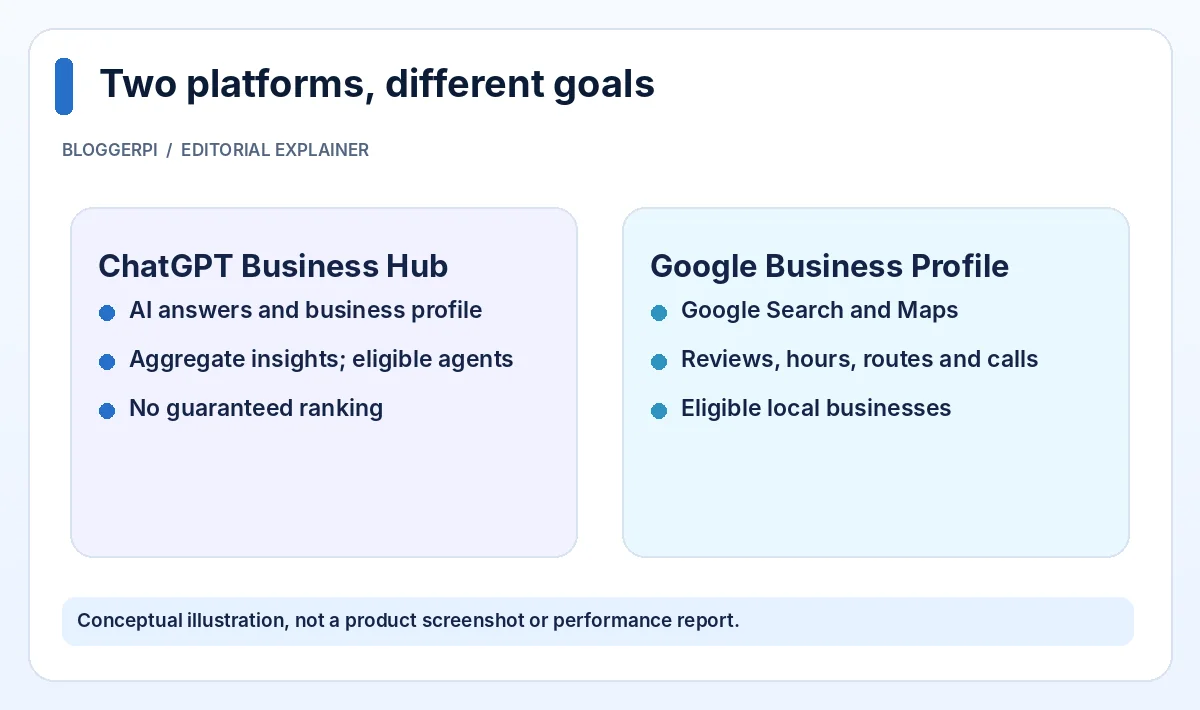
| Category | ChatGPT Business Hub | Google Business Profile |
|---|---|---|
| Main surface | ChatGPT business profiles and relevant AI conversations | Google Search and Maps |
| Primary purpose | Manage official information within ChatGPT experiences | Manage eligible local business information on Google |
| Eligibility | Depends on industry, location and verification support | Typically direct in-person customer contact |
| Verification | Initial claim plus Persona for advanced features | Google’s offered business verification process |
| Typical details | Website, description, category, brand assets and relevant policies | Address, hours, service area, photos, phone and reviews |
| Insights | Aggregate mentions, website clicks and discovery topics | Views, searches, calls, directions, clicks and related actions |
| Distinct tools | Eligible Business Agents and product feeds | Public reviews, directions and local business interactions |
| Ranking | Claiming does not guarantee recommendation placement | Profile verification does not guarantee a specific local rank |
This table is a functional comparison, not a scorecard for which company has a larger audience or a better ranking system. The two platforms report different types of events. Even the phrase “website clicks” must be interpreted within each provider’s definitions. A direct comparison without methodology can mislead an owner into thinking one channel has outperformed another.
Eligibility: Ecommerce Companies, Restaurants and Service-Area Businesses
Online stores and remote-first services
OpenAI says eligible businesses may claim a profile where ChatGPT is available and verification is supported, with access influenced by industry and location. Eligible online businesses can sometimes add a missing profile. Business Agent eligibility is more restrictive, focused at launch on qualifying US ecommerce and online services. These distinctions matter to businesses outside the United States.
For Google, a website-only retailer that never meets customers in person generally falls outside Business Profile guidelines. A company with a real showroom that customers can visit might be assessed differently, but the business must be represented truthfully. A false storefront address, virtual office or unrelated service category is not an appropriate workaround. Read the Google guidelines before trying to create a profile.
Restaurants, physical stores and service-area providers
A restaurant or local store often benefits from Maps and Search information that answers immediate questions: Is the business open? Where is the entrance? Can the person call or find a route? A plumber or cleaning company that visits customers can also use a service-area profile when it meets Google’s rules. Those interactions differ from the product comparisons and conversational questions more typical of a Business Agent.
OpenAI’s Help Center currently limits local stores and restaurants to claiming an existing US listing. That is particularly relevant to business owners in Indonesia, who should not assume a newly created local ChatGPT listing is available just because they have an active Google Maps profile. Our Indonesian business eligibility guide covers those boundaries.
How Claiming and Verification Differ
ChatGPT Business Hub initially asks an authorized claimant to prove a connection to the business through an available method. OpenAI reviews the claim and then requires Persona identity approval for business-information publication, feed connections and available insights. A blue verified badge is tied to Persona approval, not merely to placing a TXT record in DNS. If the company is eligible for an agent, it must also configure and publish that agent separately.
Google Business Profile asks an eligible owner or manager to add or claim the profile and follow a verification method selected by Google. Some information changes may not appear until verification is complete. Methods and supporting evidence vary, especially for businesses that manage locations or service areas. Administrators should follow the actual instructions rather than assuming all Google verifications use postcards or all ChatGPT claims use DNS.
Verification is platform-specific. A verified Google listing does not approve a ChatGPT Persona review, and a ChatGPT business-domain record does not verify a Google Business Profile. That also means agencies need separate permissions and a clear handover process for each platform. For ChatGPT instructions, see our business email, DNS and Persona guide.
Customer Experience: AI Conversations Versus Local Actions
Questions, comparisons and product context in ChatGPT
ChatGPT may help customers compare categories, explore trade-offs or understand a product before they visit a website. A business profile provides an additional source of official details, while an eligible Business Agent offers a clearly labeled conversation dedicated to one company. An agent currently explains offers and links to a website rather than completing purchases, making bookings or checking individual orders within that experience.
Retailers that qualify can connect structured product feeds through Shopify or supported file uploads. Feed information can include current pricing and stock availability, but submission does not guarantee that products will be recommended. Customers can continue to rely on the business’s official site to complete the purchase and read full terms.
Directions, hours, reviews and local confidence in Google
Google Search and Maps are often better suited to immediate local actions. A person can inspect the hours of a café, compare photos and public reviews, request directions to a shop or call a nearby service provider. Businesses should keep those details accurate, especially when hours change on public holidays, an office relocates or a customer-facing phone number is replaced.
For an organization with both online and physical operations, the two environments may complement one another. A shopper might research a product with ChatGPT and then check Google Maps for a nearby retailer. That is a possible customer journey, not a claim that the platforms automatically share data or that every user follows the same pattern.
Understanding the Different Performance Metrics
OpenAI defines an online-business mention as an instance when ChatGPT references the company’s website; simply naming a brand does not necessarily count. Discovery topics aggregate themes across relevant answers and do not reveal individual customer prompts. Insight cards can remain blank because the reporting threshold has not been reached, data is still collecting, or reports are unavailable. Learn more in our Business Insights analysis guide.
Google Business Profile Performance provides its own measurements for Search and Maps. Google documents searches, profile views, directions requests, website clicks, calls, messages, bookings and other features where applicable. Views follow specific unique-visitor counting rules, and some performance data includes both organic activity and Google Ads. Certain metrics can also have different update schedules.
A business therefore should not equate 100 ChatGPT mentions with 100 Google profile views, or assume that the same website-click value represents an identical session count. Use each platform to monitor trends in its own environment, and compare actual downstream business outcomes in the company’s analytics or CRM where those outcomes can be measured consistently.
How Both Fit into SEO and Business Discovery
Google Business Profile is often an important part of local search management because it lets eligible businesses present accurate information where customers use Search and Maps. But verification itself does not promise a top placement. Useful customer information, genuine reputation management and a reliable website still matter. Avoid keyword stuffing in the business name or creating duplicate locations to seek a ranking advantage.
OpenAI explicitly states that claiming a business does not guarantee increased visibility or direct control of independent ChatGPT recommendations. Treat Business Hub as an official information-management channel rather than an AI ranking purchase. For broader discovery, continue developing helpful website pages and a balanced ChatGPT Search strategy.
Which Should Different Businesses Prioritize?
- Local restaurants and cafés: Google Business Profile is a practical priority where eligible because it supports hours, directions, photos and reviews; watch ChatGPT’s rollout separately.
- Service-area businesses: keep the eligible Google service area and contact details accurate, while answering detailed customer questions on the business website.
- Online-only retailers: focus on product pages and supported ecommerce integrations, and check ChatGPT Business Hub eligibility without inventing a Google storefront.
- Remote digital agencies: maintain credible service pages, case studies and contact options, and use only profiles that match the company’s real operating model.
- Hybrid retailers: a genuine physical location and online catalog may benefit from both systems, subject to separate permissions and verification.
The optimal approach also depends on customer behavior and how the company measures success. An offline retail location may value calls and directions, while a subscription software company may care more about qualified enquiries after someone reads a service comparison. Those outcomes should determine the priorities, not a contest between two dashboard names.
A Practical Cross-Platform Management Plan
- Define authoritative company details: trading name, website, service area, address where appropriate, contact numbers and current policies.
- Record the owners, agency access and verification status separately for Google Business Profile and ChatGPT Business Hub.
- Review frequently changing details such as opening hours, inventory, delivery policies and discontinued services.
- Submit updates through each supported platform rather than assuming changes synchronize automatically.
- Evaluate each platform’s reports according to its own definitions and connect relevant activity to genuine website or customer outcomes.
Multi-location companies should also account for differences in management. Google provides tools for multiple eligible locations, while OpenAI currently describes separate handling of distinct brands and locations, without a universal centralized parent-brand management capability. A company operating franchises or multiple trading names needs a documented governance process for each service.
Infographic: Six Key Differences
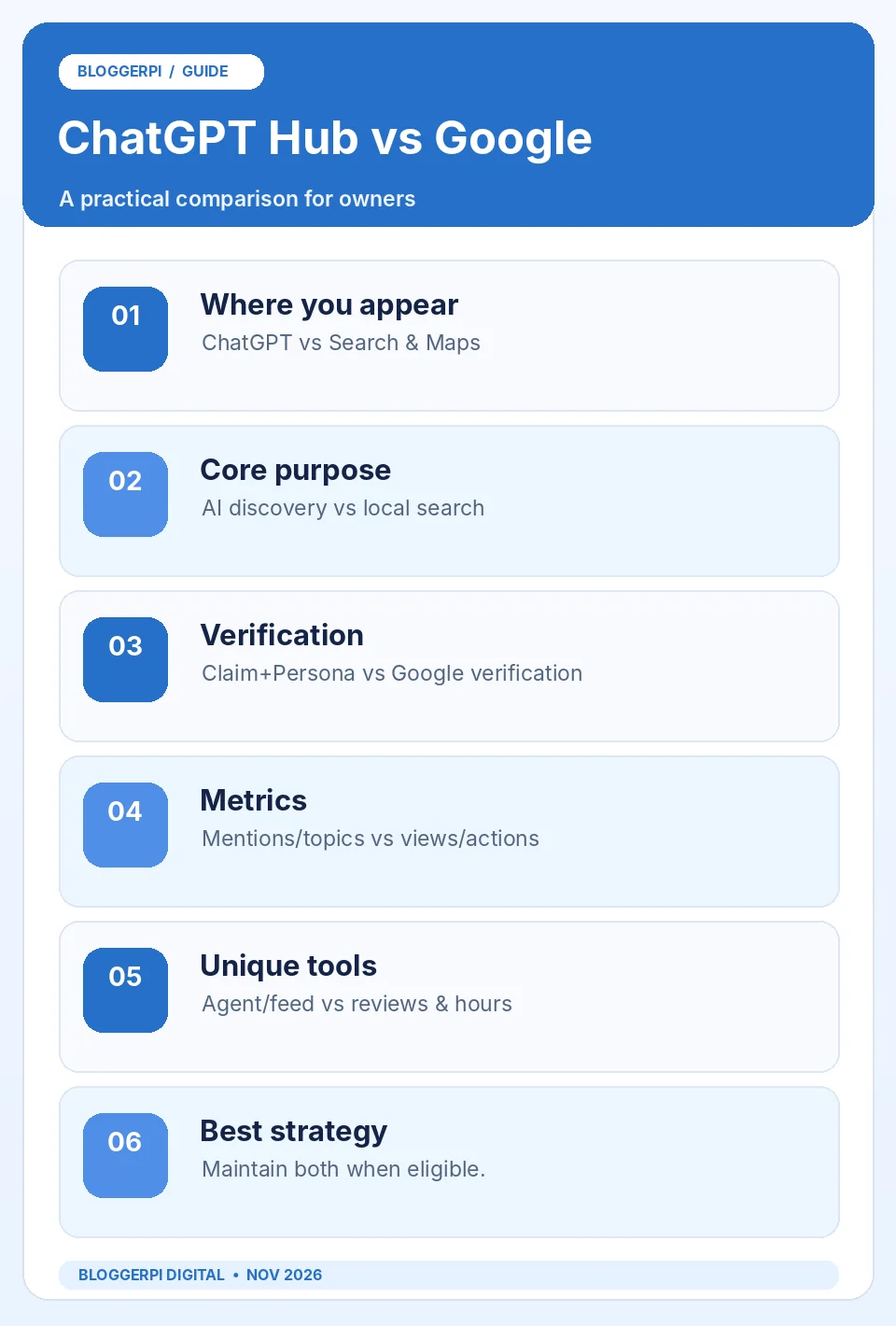
The infographic summarizes platforms, purposes, verification, metrics, unique capabilities and the practical strategy. The important conclusion is not that every business needs both. The right choice is determined by actual eligibility and the customer’s path to discovering or contacting a business.
Frequently Asked Questions
Does ChatGPT Business Hub replace Google Business Profile?
No. ChatGPT focuses on business information and AI conversations; Google Business Profile is designed for eligible local businesses in Search and Maps.
Can online-only businesses use Google Business Profile?
A business without in-person customer contact generally does not meet Google’s Business Profile eligibility guidelines.
Can an Indonesian business claim a ChatGPT profile?
Only when the business is eligible and supported verification is available. Local stores and restaurants currently have restrictions involving existing US listings.
Does Google verification also verify ChatGPT?
No. Each service has its own claim and identity-verification process.
Are public reviews a core ChatGPT Business Hub feature?
The documented product centers on business information, aggregate insights, feeds and eligible agents; do not assume it has Google’s public-review system.
Are website-click metrics directly comparable?
Not necessarily. The platforms define and collect actions differently.
Will either verification guarantee higher rankings?
No. OpenAI does not promise placement from claims, and Google verification alone is not a guarantee of a specific local ranking.
Which is more useful for a local restaurant?
For an eligible local restaurant, Google Business Profile is often immediately useful because of hours, reviews, directions and Maps discovery.
Conclusion
ChatGPT Business Hub and Google Business Profile are complementary only when the organization actually qualifies for both and customers have a reason to use each. The former addresses business information and conversational discovery in ChatGPT; the latter provides local visibility and actions through Search and Maps. Their verification, capabilities and metrics should be managed independently.
Begin with the channels most relevant to your customers, keep official information consistent, and avoid unsupported claims about guaranteed recommendations. For a new ChatGPT listing, follow our claiming tutorial; for local search, follow Google’s current Business Profile guidelines. A good cross-platform strategy starts with truthful information and measurable customer outcomes.
Official Sources
- OpenAI — Setting up your business on ChatGPT
- OpenAI — Businesses in ChatGPT
- Google — Add or claim your Business Profile
- Google — Guidelines for representing your business
- Google — Understand Business Profile performance and insights
