

Does claiming your business make ChatGPT recommend your website more often? Not necessarily. OpenAI explicitly states that a claim does not guarantee increased visibility or give the business direct control over the independent recommendations made by ChatGPT. A business that is claimed, verified, and actively maintained can still be omitted from a particular answer. Likewise, ChatGPT may mention an unclaimed business when its information is relevant to the question.
This is an important distinction for founders, ecommerce managers and marketers who have seen the new Claim your business option in Business Hub. A listing claim is useful, but it is primarily a way to manage official information—not a switch that promotes a business to the top of every response. In this article, we examine the launch documentation, separate measurable benefits from ranking assumptions, and outline a more defensible strategy for business discovery through AI.
Reviewed on November 16, 2026. Businesses in ChatGPT launched in beta on November 10. Eligibility and some controls can change. Where we discuss possible indirect improvements to customer experience, those are editorial interpretations rather than an OpenAI guarantee of ranking or sales.
What OpenAI Actually Says About Claims and Recommendations
The official OpenAI Business Hub guide answers the recommendation question directly: a claim lets owners manage the information they provide, but it does not guarantee that a business becomes more visible in ChatGPT or acquires more control over independent recommendations. OpenAI also confirms that advertising does not influence those independent answers. Paid sponsorship and the assistant’s regular comparisons are designed as distinct experiences.
There are two common misreadings of this rule. One is to conclude that claiming has no value at all; the other is to claim that the blue check is a hidden AI ranking factor. Neither follows from the documentation. Managing a profile can improve the accuracy of information that might be shown to people, while the recommendation decision remains outside the owner’s direct control. The more precise question is therefore what a business can legitimately change and measure after verification.
If your team is also researching search visibility, distinguish this from the broader issues covered in our ChatGPT Search and SEO guide. Ranking, content retrieval, official profile management, and customer conversion are related business concerns, but they are not interchangeable measures.
What Changes When a Business Is Successfully Claimed?
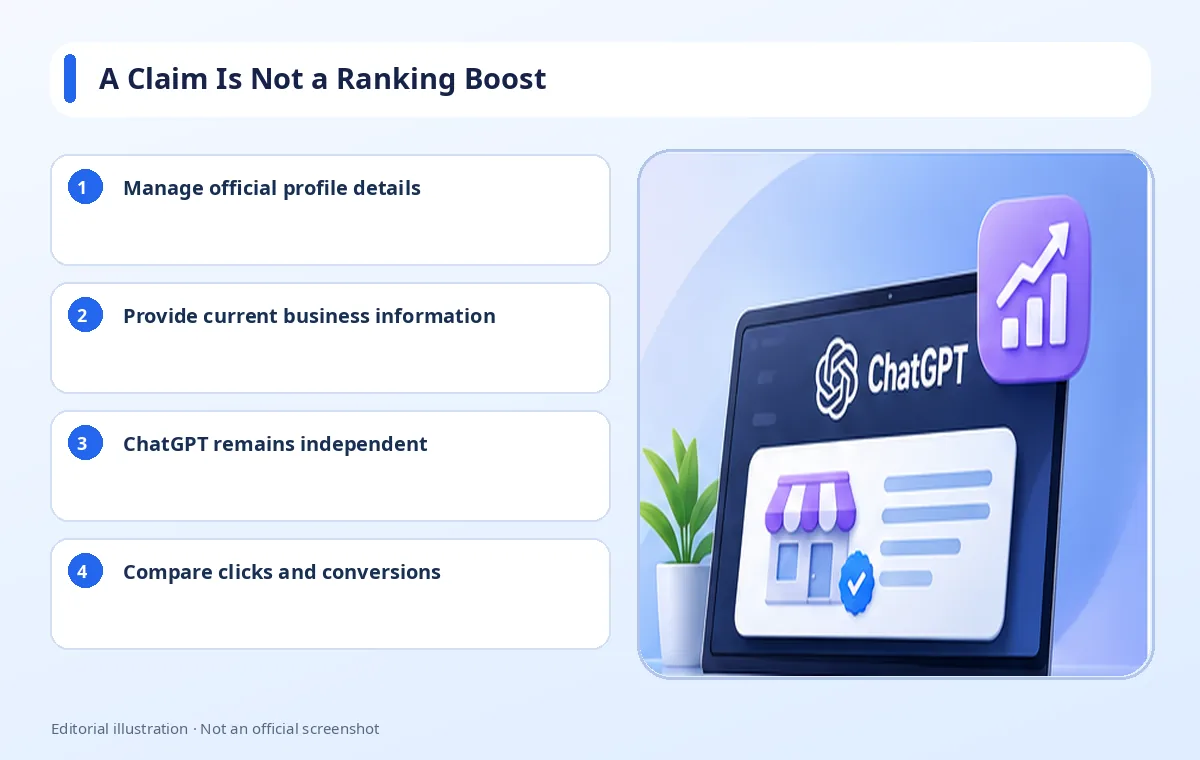
A successful claim gives the authorized business account access to its listing in Business Hub. Depending on the original method offered, the claim may have been supported by an email code, business phone, a domain DNS TXT record, or Shopify. OpenAI reviews the request and communicates its decision. After approval, the organization can access the profile, but some additional tools remain restricted until Persona identity verification is approved.
Once that separate identity check is complete, the organization can submit updates to information such as its website, business description, product or service category, logo, cover photo, delivery terms or returns policy, where the fields apply. OpenAI reviews submitted changes and publishes them according to its process. That means an update saved in Business Hub should not be described as instantly replacing every answer ChatGPT might produce.
The operational benefit is more modest but still meaningful. A buyer who encounters a business listing may have access to a correct website or more accurate policy details rather than an outdated link. An authorized manager can identify a mistaken product category and submit a correction. These outcomes contribute to better information quality, but they are not direct evidence that the business appears more often in recommendations.
A Business Claim Is Not the Same as a Verified Badge, Feed or Agent
Claimed listing
The initial claim proves a connection to the organization using an accepted method. It gives the business a way to administer the listing once approved. It does not authorize the owner to dictate how ChatGPT should compare the business with competitors, and the approval itself does not satisfy all of the requirements for publishing profile changes.
Blue verification badge
OpenAI’s Help Center connects the blue verified badge to approved Persona identity verification, not merely the initial ownership check. A verified badge can communicate the status of the profile, but no public claim in the documentation establishes it as a guaranteed ranking benefit. Marketers should not turn an administrative badge into a promise of preferred search placement.
Product feeds
Eligible retailers may provide product data through Shopify or a CSV feed that follows OpenAI’s specification. A feed can include current pricing and availability and make official product details available to the service. Yet the documentation explicitly says connecting a product feed does not guarantee product recommendations, and a feed does not automatically create or publish an agent. The retailer remains responsible for keeping offers accurate.
Business Agents
A Business Agent is a separately labeled conversation with a particular business. Eligible organizations can configure the information and policies used to answer customers and publish the experience only after review. At the November 2026 launch, agent eligibility is limited to qualifying ecommerce and online services in the United States. A company outside that group can have a claimed profile without an active agent.
Can ChatGPT Recommend an Unclaimed Business?
Yes. OpenAI says that information about a business can appear in ChatGPT even when the owner has not created or published an agent. When the system addresses a relevant query, it may draw from various available sources. A profile claim does not replace those sources or force the model to use only company-submitted material. That distinction is central to preserving the independence of comparisons.
Consider a visitor who asks for a service provider capable of creating SEO-friendly content for a small business. The useful response depends on the service needed, geography, evidence and other available information. An agency that has claimed its profile might provide a more accurate link and service description, but it still cannot require ChatGPT to list it first. The owner can make the business easier to understand, not take ownership of the assistant’s recommendation process.
That is also why a sound content plan remains important. The ideas behind experience, expertise, authoritativeness and trust can guide transparent service pages and credible evidence. It would be a mistake, however, to imply that a single E-E-A-T score or a badge has been confirmed as a ChatGPT ranking input.
Realistic Indirect Benefits for an Owner
- More reliable official details. The correct website, product category and contact information reduce ambiguity for prospective customers.
- Clearer business context. Accurate descriptions and policies help people understand whether an offering matches what they need.
- Authorized collaboration. The claiming admin may grant eligible colleagues or agencies access rather than sharing a personal account password.
- Current commerce data. Retailers with supported feeds can maintain product prices and availability through an official channel.
- Aggregated reporting. Where available and privacy thresholds are met, owners can inspect mentions, website clicks and discovery topics.
These are process and information-quality benefits. None should be converted into an unsupported figure for how much visibility will rise. A cleaner profile may make a customer decision easier, but whether it changes user behavior should be evaluated with appropriate evidence. In particular, even an increased volume of reported mentions would not by itself prove that the profile claim caused the change.
What to Optimize Without Chasing a Guaranteed AI Ranking
Maintain accurate identity across your website
Audit the official brand name, category, service region, website address, contact options and policies. Make sure they match what the company actually offers. The Businesses in ChatGPT policy prohibits impersonation, duplicate fake profiles, deceptive links, fabricated endorsements, and unsupported claims about price, credentials or results. Owners should treat those rules as a starting point for trustworthy publishing—not simply a box to check for verification.
When an agency manages several clients, record who is authorized to represent each company. Do not assume ownership of a parent brand automatically grants control of every individual business location. For multiple brands or branches, the correct permissions and listing paths may differ. A clear internal record also protects the organization when employees or agencies change.
Improve pages that help customers decide
A business website should make the main offer understandable without extensive digging. Service pages can describe scope, limitations, deliverables and ways to request a quote. Product pages can provide specifications, sizes, stock and clear delivery or return policies. These improvements often have a more immediate path to customer satisfaction than trying to influence a model’s answers. Consider usability testing to identify points of confusion.
Publish useful supporting content
Customer FAQs, fair comparisons, evidence-based case studies and explanations of product limitations can make an offering easier to assess. Avoid filling pages with repeated “recommended by ChatGPT” phrases, especially when there is no evidence supporting the claim. Instead, focus on questions actual buyers ask and document information that a person can verify. A resource such as our SEO tools guide can support independent research and site auditing.
Interpret Insights with care
When the owner has passed Persona and reporting is available, Business Hub may show mentions, website clicks and discovery topics. OpenAI counts an online-business mention when ChatGPT references the website; simply naming the brand is not automatically counted. Metrics may remain blank because of minimum privacy thresholds, data collection delays or unavailable reporting. A blank card must not be treated as confirmed zero exposure. Compare any available insights with on-site engagement and conversions.
How to Measure Post-Claim Outcomes Responsibly
A simple scorecard should begin with changes that can be confirmed. For example, on what date did the business gain access? Was Persona approved? Were its official URL and contact details correct? Did OpenAI publish the updated description? Are product policies consistent between the website and Business Hub? Those facts can be documented even when mentions and clicks are not yet available.
If reporting later shows a change, compare equivalent periods and note other influences: marketing campaigns, seasonal demand, website updates, changes to the product catalog, or variations in reporting availability. Do not tell stakeholders that an increase in mentions was caused by verification without a way to test that claim. Equally, a drop in a short reporting window should not be treated as proof that a claim damaged visibility.
For commerce businesses, track customer outcomes in the appropriate system. Website clicks and actual enquiries are different events; an enquiry and completed sale are also different. Integrating these distinctions into your reporting protects against overstatement. Our broader traffic growth guide offers complementary ideas for measuring site performance without pretending that any single platform gives the complete picture.
Infographic: What a Claim Can and Cannot Change
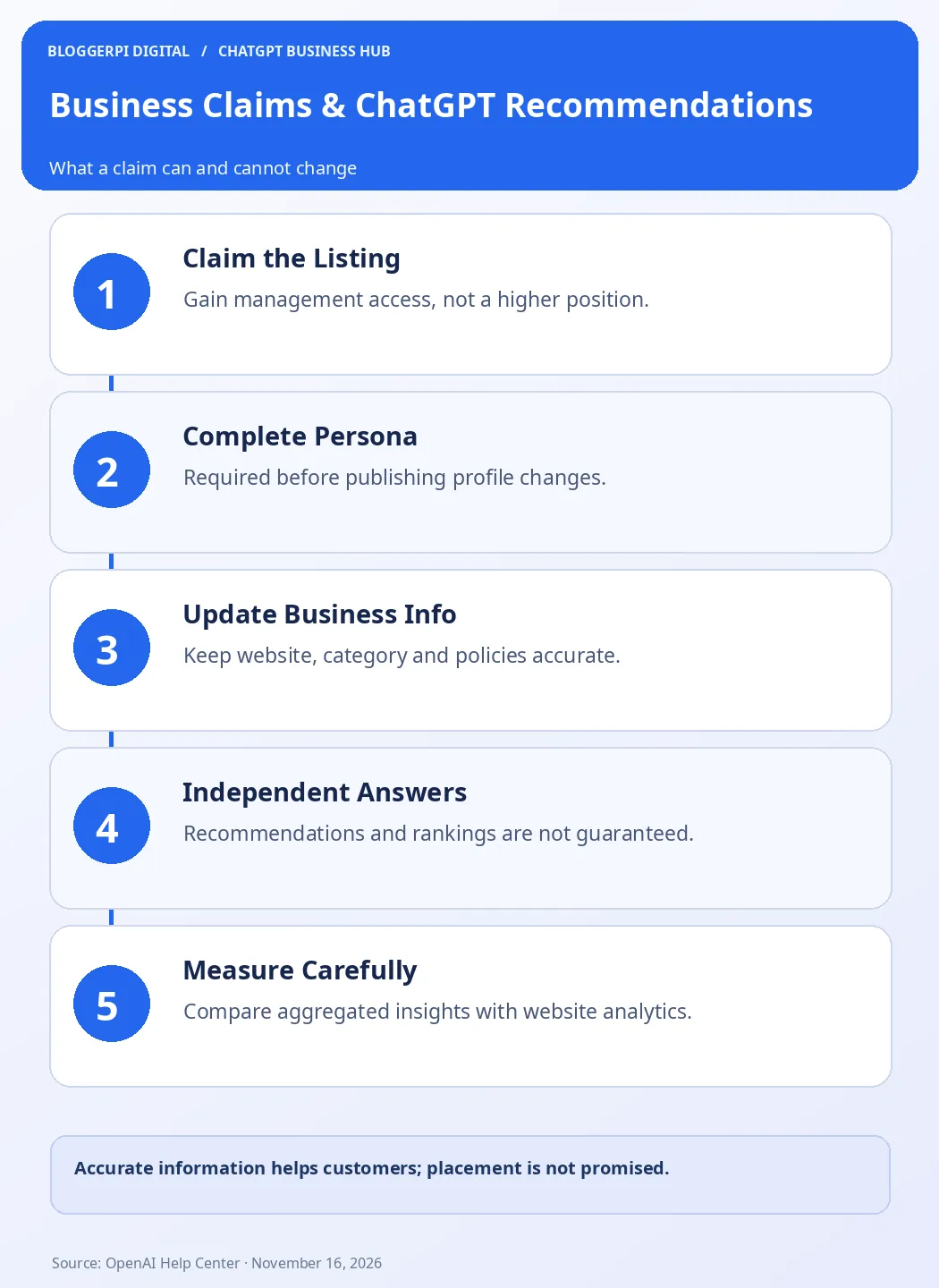
The infographic is a practical summary, not an official ranking formula. The sequence starts with authorized management, proceeds through identity verification and accurate information, and ends with measurement. At no point does it assume that the blue check, product feed, paid workspace or advertised agent can force a preferential ranking in ChatGPT’s independent answers.
Frequently Asked Questions
Will claiming my business automatically increase ChatGPT visibility?
No. OpenAI expressly says it does not guarantee greater visibility or direct control of independent recommendations.
Does a blue verification check improve ranking?
The blue check relates to Persona verification approval. The documentation does not promise a ranking benefit from the badge.
Can advertising make ChatGPT recommend a business more often?
Advertising is distinct from independent ChatGPT answers and does not influence their recommendations.
Can an unclaimed business appear in an answer?
Yes. ChatGPT can reference relevant businesses without the owner publishing an agent or managing a claim.
Does a product feed guarantee products will be recommended?
No. A feed provides commerce information but is not a placement guarantee or a replacement for the separate agent publishing process.
Why are my Mentions blank after claiming?
The reporting threshold may not be met, data may still be collecting, or reporting may be unavailable. Blank does not necessarily mean zero.
Do I need a ChatGPT Business subscription to claim?
No. OpenAI says an eligible business does not need an Ads account or ChatGPT Enterprise contract for the basic claim.
What should a small business do first?
Claim and verify legitimately, correct official information, improve the customer journey on its website, and monitor real outcomes.
Conclusion: Useful Business Infrastructure, Not a Ranking Shortcut
Claiming a business in ChatGPT is worth considering for companies that want an official way to manage details and understand available aggregate engagement. Its value is strongest when it produces more accurate information and a better path for prospective customers. It is not a promise that the assistant will show the business in every answer or rank it above competitors.
Begin with the practical claim and verification walkthrough, review what customers see on the website, and establish a reporting baseline. If your organization needs stronger site content, Bloggerpi’s content writing service can support that separate work without claiming an unverified AI ranking outcome.
Official References
- OpenAI Help Center — Setting up your business on ChatGPT
- OpenAI — Businesses in ChatGPT
- OpenAI — Introducing Businesses in ChatGPT (November 10, 2026)
- OpenAI — Businesses in ChatGPT Policy
